
 Canada
Canada CRE News In Your Inbox.
Sign up for Connect emails to stay informed with CRE stories that are 150 words or less.

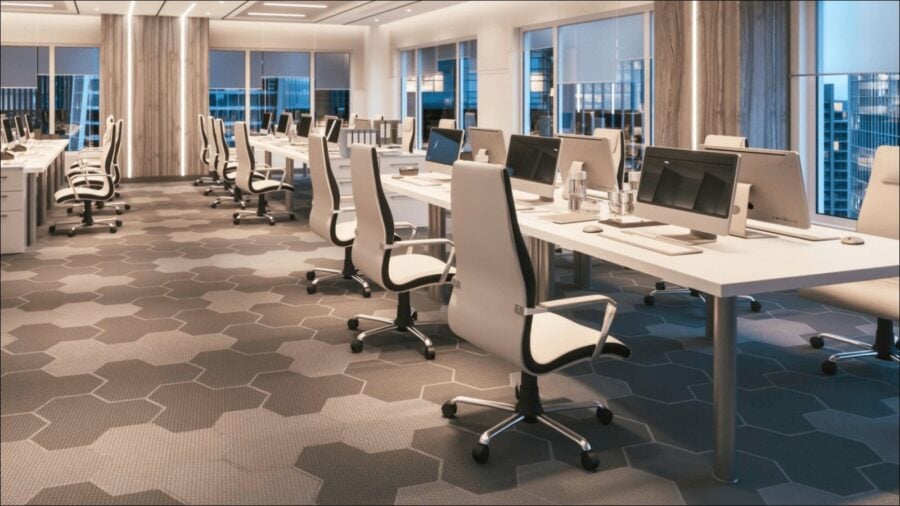

Desire for Privacy Driving Up Canadian Office-Space Demand
Employees’ desire for privacy is increasing office-space demand across Canada and could play a large role in shaping future workspace layouts, says Colliers’ head of real estate management services.
John Duda told Connect that demand has increased as tenants’ employees seek to work further apart from colleagues in order to complete tasks more efficiently without disruption. Consequently, the amount of square footage per employee has risen and workers are sharing less space as the return-to-office movement ramps up and more workers return to company premises in the post-pandemic era.
Tenants’ employees are looking for an experience now in office buildings, and data shows that they will not want to come back if they feel that they can have more privacy and get more work done at home, according to Duda.
“From a leadership perspective, I think this is now becoming well-understood and people are adapting their space,” said Duda. “So, it’s driving up the amount of space they need. Plus, the amount of [employees’] days in the office is more, and it’s at a point where [tenants] need a full floor without sharing space.”
Duda co-ordinated a Colliers report that, as Connect reported previously, found that the tide has shifted in Canada’s office market office market and the second has reached an inflection point. The national office vacancy rate is expected to return to pre-pandemic levels by 2029, as improving tenant demand and stronger leasing activity signal a gradual market recovery.
Colliers’ occupier survey results show that space-sharing is employees’ top irritant, Duda said.
“That was a very big theme,” said Duda. “I’ve had it in my own office with staff. And, the response has been that a lot of the sharing of space has diminished, if not been eliminated.”
As a result of employees’ desire for more privacy, tenants are likely to seek a greater variety of office spaces in the future.
“I think it’ll be tailored to the type of job you do,” he added. “If the type of job you do is collaborative and you need to be in a bullpen-type environment, where you need to be able to turn around and talk to people and work with them, like in a marketing-type function, well then you would have a more open type of space.
“But if you have somebody like we have, who’s sitting down and they’re drafting legal documents like leases, no, they cannot be distracted in doing their job. They need privacy and they need quiet space. … I think it will be less open and more tailored to jobs that are being done.”
The Colliers report states that national office vacancy peaked at 14.9% in 2025, marking the high point of hybrid work’s impact on demand. Based on economic forecasts calling for average GDP growth of about 2% annually over the next three years, vacancy is projected to decline to roughly 8% by 2029 — a level not seen since late 2019.
Tenant sentiment has shifted notably. Only 11% of occupiers now expect to reduce their space requirements, the lowest share since 2020, while 17% anticipate expanding — a significant year-over-year increase. This renewed confidence, along with new market entrants, is expected to support absorption and drive vacancy lower.
Amenities, in terms of availability, type and quality, will also play a key role in boosting demand and reducing vacancy in office buildings across Canada, said Duda.
“Tenants are more interested in amenities now than they were in the past,” he said. “There’s more analysis being done. So when presentations are being made to prospective tenants, there’s a big focus on the types of amenities, not only in the building, but in the area. I think that is a big, big deal. It’s probably one of the overarching deals [i.e. concerns] because it’s one of the only things you can really control.”
And as with workspaces, a greater variety of amenities will need to be offered according to occupiers’ wishes.
“I have Uber’s research [team] in one of my buildings,” he said. “They wanted a full-on restaurant inside their tenant space. They wanted grills. They wanted a chef. Now, I have World Bank in World Bank Plaza here [in Toronto.]. They’re not looking for that for their staff, like not even close.
“So, the tenants have very different needs. This is where I don’t think you will ever see a one-size-fits-all. And, I think the companies that are successful and landlords that are successful, they’re going to tailor the amenities to the occupants in a building.”
Duda added that virtually every office tower that he has toured in Calgary has a fitness centre, but they do not all need them because of different demand for them in each location. He suggested that many building owners have spent millions of dollars on fitness facilities that they do not need, based on demand, but are installing them because they numerous occupiers have talked about them.
Building owners and managers must develop flexible amenity structures that can be changed so that they can change over time as a building’s tenancy evolves. Based on Colliers’ survey results, there is no overarching amenity that meets that all tenants covet.
But proximity to amenities will be a key factor. GWL Realty Advisors has developed a standalone amenities building next to one of the company’s office towers in downtown Toronto to maintain long-term occupancy. But, said Duda, that approach might not work for all developers and asset managers.
Amenities’ success will depend on how they fit into each community and how convenient they are in each.
“If you have an amenity that is inconvenient, if [office occupiers] have to walk two blocks in the snow to get to an amenity, I can pretty much guarantee most people won’t do it,” said Duda.
Community, convenience and building environmental aspects, such as good internal air quality and low building emission levels, comprise the three pillars of office-leasing success, the Colliers expert added.
In the 15 years that Duda has been with the company, his team has conducted annual occupier surveys, and tenants’ top two concerns have never changed, with rent prices and a building’s proximity to diverse transit options always prevailing. He noted that World Bank Plaza is fully leased because its tenants have nearby access to “every mode of transportation.”
Since 2020, he said, Colliers has only been off on its annual vacancy prediction by 20 basis point after surveying tenants across all asset classes and tenants of all sizes. During that time, the accuracy has increased exponentially.
“So, we have become very confident in our information,” he said. “That doesn’t mean unusual things can’t happen. I mean, COVID did.”
Colliers used AI extensive to analyze its survey results and make the annual vacancy prediction.
“It is an eye opener in that we can be far more specific about what we’re doing and trying to achieve,” said Duda. “And, I think that ultimately means you’re going to have a better tenant mix.”
Photo: Colliers
If you’re making investment, development, or lending decisions in today’s Canadian commercial real estate market, Connect CRE Canada in Toronto on June 25 is where you need to be. Join an audience of 200 investors, lenders, brokers, developers, and owners for high-level networking and timely discussions on the trends impacting today’s market. Hear from industry leaders at TD Asset Management, Starlight, Woodbourne Capital Management, REMAX, Fengate Asset Management, Stonebridge Financial, Yardi, and more. Register now to gain the insights and connections to navigate an evolving landscape.
- ◦Lease
- ◦Sale/Acquisition