
 B.C.
B.C.Canada CRE News In Your Inbox.
Sign up for Connect emails to stay informed with CRE stories that are 150 words or less.

Court Denies Montrose Attempt to Reopen Cowichan Case
A B.C. Supreme Court judge has denied Montrose Properties’ request to reopen the Cowichan Aboriginal-title case, calling the attempt “an abuse of process for relitigation.”
The decision follows last August’s landmark ruling recognizing the Cowichan Nation’s Aboriginal title over portions of Crown, municipal and private land in Richmond, B.C. and other parts of the province’s southwestern region. The court found that the Crown’s granting of private land titles had “unjustifiably” infringed on the Cowichan Nation’s Aboriginal title. While the ruling recognized title over private lands, the Cowichan Nation is not seeking to invalidate existing private ownership or claim those lands. All parties have appealed the original decision.
“Four of the five issues that Montrose seeks to address if the trial was reopened were fully argued and litigated by the parties at trial, and the subject of discussion and determinations in the final reasons,” wrote Justice Barbara Young in her decision, according to a Cowichan news release. “The remaining issue, the applicability of provincial laws, including 38 statutes, is not an appropriate issue for the Court to determine in these proceedings as the issue does not arise on the pleadings and there is an absence of any live controversy or dispute.”
Montrose, the area’s largest landowner, argued it had been unfairly excluded from the original trial, which lasted more than 500 days, and that the declaration of Aboriginal title directly affected its fee-simple property interests. Justice Barbara Young ruled, however, that the company knew about the proceedings and chose not to seek party status until after the trial had concluded, CBC reported.
“I agree with the plaintiffs that allowing this application could open the floodgates for numerous other private landowners and persons with commercial or other interests in the Cowichan Title Lands to seek to join the litigation,” Young wrote, according to CBC.
She added that such a process would be “inefficient, disruptive to the parties, and would not enhance the integrity of the administration of justice.”
Young also warned that “allowing this application could incentivize third parties to take a wait-and-see approach to joining litigation until after reasons for judgment are released,” rather than participating in a timely manner. She said Montrose’s concerns had already been addressed during the lengthy trial involving well-resourced parties.
Montrose CEO Ken Low said in a statement that the company is reviewing the decision and that there are “a few legal options to consider.”
“But we are not done, and private property rights must be protected,” he said in a statement released by the law firm that represented Montrose in court.
Cowichan Tribes Chief Cindy Daniels welcomed the ruling, saying the First Nation could now focus on respectful reconciliation efforts.
Lyackson First Nation hereditary chief Shana Thomas said: “The Cowichan decision resulted from a lengthy and thorough judicial process, and the court’s dismissal of the application to reopen the case reinforces the integrity of that process.”
The ruling has intensified political debate in British Columbia, with the Opposition Conservatives calling for legislation to protect private property rights and greater public disclosure of Aboriginal title claims before the courts or under negotiation. Scott McInnis, the party’s Indigenous relations critic, said the government should “immediately disclose every Aboriginal title claim currently before the courts or in negotiation, so people can come forward and get into litigation at the earliest possible stage, not when it’s too late.”
In filing its application to reopen the decision, Montrose had contended that the court had both the ability and responsibility to reopen the case because the final order Aboriginal-title had not yet been delivered.
Montrose filed its application to avoid having to await the outcome of a lengthy appeal process.
The court’s decision recognized Aboriginal title for the Cowichan, who are based on Vancouver Island but operated a fishing village on the south arm of the Fraser River during the 1800s in an area that is now part of Richmond.
Paul Sullivan, a Vancouver-based property tax expert with Ryan, previously told The Globe and Mail that the court’s decision has decimated property values in the affected area.
Sullivan’s clients currently make up more than half of the property owners in the affected area.
In an 863-page ruling, Young said that the Cowichan have established Aboriginal title to roughly 800 acres of Richmond, along with an Aboriginal right to fish for food. According to the Globe, the trial was billed as the longest in Canadian history.
Young also ruled that private ownership, known as fee simple title, and ownership interests held by the federal government and City of Richmond in the lands are “defective and invalid.” The judge has suspended the decision for 18 months, so that the Cowichan, federal government and city can “make the necessary arrangements.”
Montrose ranks as the largest single landowner in the affected area, with holdings that include a Coca-Cola bottling plant and a Canadian Tire depot, the Globe reported.
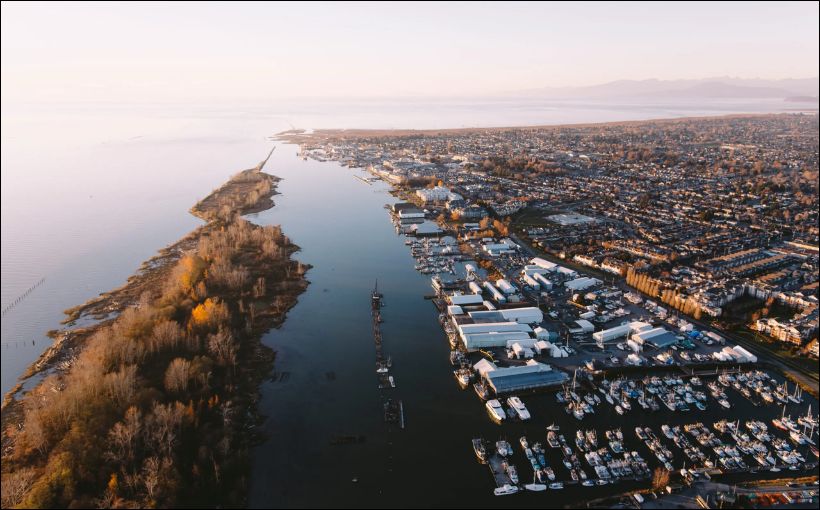
Pictured: Richmond, B.C.
Photo: Tourism Richmond