
 B.C.
B.C.Canada CRE News In Your Inbox.
Sign up for Connect emails to stay informed with CRE stories that are 150 words or less.

Five Indigenous Groups Receive Option to Buy, Lease Back LNG Canada Phase 2 Storage Tank
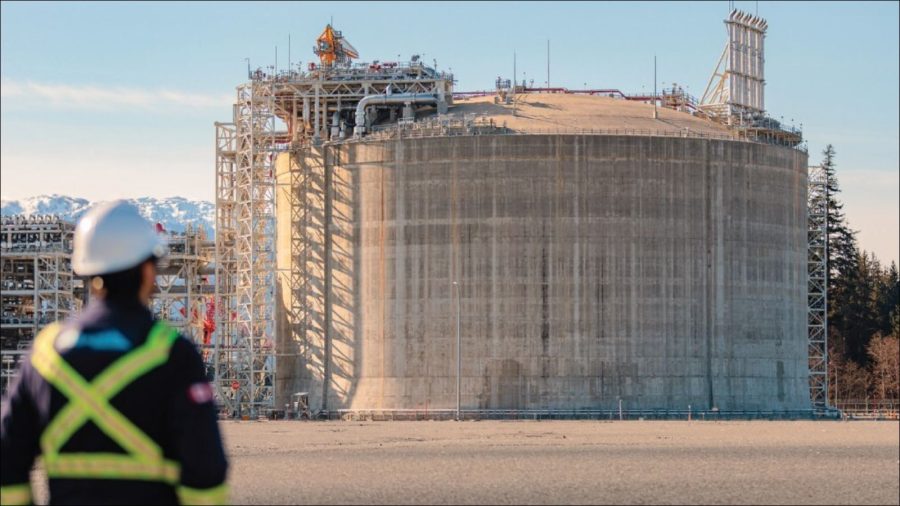
Five First Nations adjacent to LNG Canada in Kitimat, B.C., have received an option to buy and lease back a massive storage tank slated to be part of the facility’s Phase 2 expansion.
LNG Canada and its joint-venture participants announced the equity-option agreement with MNT Investments LP, a limited partnership representing the economic development organizations of the Gitga’at First Nation, Gitxaała Nation, Haisla Nation, Kitselas First Nation and Kitsumkalum.
The agreement would allow MNT Investments LP to acquire a majority equity interest for up to $1 billion in a special-purpose entity that would purchase the planned LNG storage tank for the proposed Phase 2 expansion and lease it back to LNG Canada for the life of the project. LNG Canada would continue to operate and maintain the facility.
The proposed 225,000-cubic-metre LNG storage tank is slated to be the largest in Canada and among the largest in the world. The tank would stand 56 metres high, measure 92 metres in diametre and support LNG Canada’s export facility in Kitimat.
The company said the investment would provide the participating First Nations with majority ownership in major infrastructure supporting Canada’s largest LNG export facility. The option also enables Indigenous equity in a key national and provincial priority project starting from the construction phase, representing an evolution in Indigenous infrastructure ownership.
“Our announcement reflects our continued commitment to reconciliation by creating a pathway for Indigenous equity in our proposed Phase 2 expansion,” said Chris Cooper, LNG Canada’s president and CEO. “This agreement recognizes that Indigenous Nations should have the opportunity to participate in major investments like Phase 2, not only through jobs, training, procurement and community benefits, but also through long-term ownership and value creation at a global scale.
“Together with Gitga’at, Gitxaała, Haisla, Kitselas and Kitsumkalum, we continue to work toward our shared vision of helping Canada become a top-five global LNG exporting nation and providing the world with a secure, reliable supply of lower-carbon LNG.”
The transaction is conditional on LNG Canada’s joint-venture participants approving the proposed Phase 2 expansion. A final investment decision is targeted by the end of 2026. If completed, the deal would represent one of the largest Indigenous ownership stakes in major Canadian infrastructure and a significant Indigenous investment in Canada’s LNG sector.
“This is far more than a commercial transaction,” said Linda Innes, elected chief of the Gitxaala. “It marks a fundamental shift in how development can occur in our traditional territory: One where Indigenous Nations are not expected to accept impacts but instead participate as equity owners and true partners.”
LNG Canada said the proposed Phase 2 expansion could add two additional LNG processing trains, increasing the facility’s production capacity to as much as 30 million tonnes per year. The company has shipped more than 100 LNG cargoes since commercial operations began in June 2025.
Maureen Nyce, elected chief councillor of the Haisla, said the deal reflects what is possible when industry and Indigenous communities come together as partners, investors and decision-makers.
“It reaffirms our long-standing belief that when Indigenous communities lead, the whole country can thrive,” she said. “This agreement marks a defining point in our collective history — one where Indigenous equity and ownership in energy infrastructure becomes the norm, not the exception.”
Glenn Bennett, elected chief of the Kitselas, said the deal marks “a profound shift” on how major projects are built on First Nations’ territories.
“True reconciliation is not just about consultation; it is about equity, ownership, and long-term value creation for our people,” he said. “This agreement establishes a historic pathway.
“By securing a stake in LNG Canada’s tank infrastructure, we are not just participating in Canada’s energy future; we are ensuring that future directly sustains our community for generations to come.
Shell owns a majority (40%) stake in LNG Canada, while Malaysia’s Petronas holds a 25% stake, PetroChina and Japan’s Mitsubishi each have 15% and South Korea’s Kogas has 5%.
Image: LNG Canada
- ◦Development