
 B.C.
B.C.Canada CRE News In Your Inbox.
Sign up for Connect emails to stay informed with CRE stories that are 150 words or less.

Alternative CRE Investors Share Insights at Connect Conference
Demand for alternative real estate assets will be strong for the next two years.
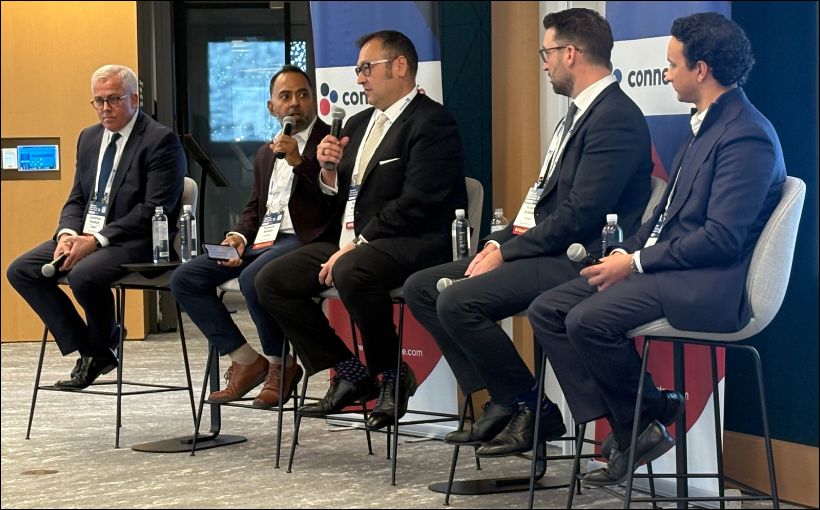
That was one of the messages Thursday as industry leaders gathered in Vancouver for the first-time Connect Alternative Real Estate investment conference.
More investments are expected in unconventional sectors like student housing, seniors housing, self-store and, particularly, data centres.
Jonathan Turnbull, managing director and head of Harrison Street, said during a panel discussion that alternative real estate is no longer a niche asset class.
“It’s just because it’s grown to that point where you can’t call it a niche,” Turnbull told Connect in an interview after the session. “It’s just too big now. But even, still, in Canada, think about the senior space, which is the most developed of the alts. It’s probably a $70- billion industry.
“That’s not a niche. That’s bigger than a lot of manufacturing sectors and things like that in this country. So, you can’t think about it as a niche.
“I think it’s easy [come to that conclusion] when everybody sees the broader picture. And, it’s easy to say because nobody really understands it. But push comes to shove, these are big industries, even in Canada.”
Prakash Venkat, head of Deloiitte’s national tangible-property valuation practice, told Connect that alternative real estate is “becoming mainstream.” He pointed to Harrison Street and Hines as examples of major investors who are focused on alternatives.
(Harrison Street has only invested in unconventional assets throughout its existence, Turnbull noted in his interview with Connect.)
Vekant predicted that demand for data centres, although now flat, will be constant once investors figure out how to source the large amount of electricity needed to operate them construction-related questions.
“How do you design it? How do you construct a data centre? Where do you do it? Do you look for the power first? Do you look for the land first?”
But Wendy Waters, an independent real estate research specialist, was not ready to classify alternatives as mainstream investments.
“[Niche] might be too strong of a word,” Waters, a long-time Canadian research leader told Connect. “But having enough trades and data point and volume of assets in the market so that you you can actually really, fully, sink into it as an asset class, I think a lot of this isn’t there yet.
“Data centres are going to get there really fast, if they really are a real estate play and not an infrastructure play, and they’re being charged by the kilowatt-hour, not by the square foot. It sounds to me like it’s an infrastructure play, which doesn’t make it a bad investment at all. It’s just whether it’s going to get tracked in real estate or get tracked more and invested in by the infrastructure team, rather than the real estate team.”
Waters was pleased to hear discussion on such assets as hotels, seniors residences, fitness centres and mixed-used developments as well as data centres.
“It’s all important,” she said. “It’s all part of the continuum, for sure, and growing in important parts. But it’s not quite the same space as office buildings, industrial parks, doing traditional industrial stuff, rental housing, that type of thing. It’s not as big. There’s just not as many assets, not as many data points.”
The first-time conference was held on Level 23 of Deloitte Summit in downtown Vancouver.
Vekant appreciated the chance to network with industry players as well as the insights that were shared.
“This is what I like about conferences,” he told Connect. “You get to meet and talk to people whom it’s generally hard to get hold of.”
Sessions included a special presentation from Venkat on the value that alternative real estate can offer, along with a panel discussion on how industry leaders are navigating macroeconomic headwinds, evolving demographics and changing regulation to capitalize on value and opportunities in alternative sectors.
In another panel discussion, leaders offered their views on how to close deals amid demands for creativity and collaboration among investors, lenders and brokers. During a special session, Derek Fluker, Wesgroup’s chief investment officer, called for the industry to push local governments to change development cost charges and other fees that are hampering investment and development.
Pictured: Participants in a panel discussion at the Connect Alternative Real Estate Investment conference in Vancouver on Thursday.
Photo: Monte Stewart. All rights reserved. No republishing permitted.