
 Canada
Canada CRE News In Your Inbox.
Sign up for Connect emails to stay informed with CRE stories that are 150 words or less.


Avison Young Expects CRE Investment to Increase in Second Half of Year
Canadian commercial real estate investment is expected to increase in the second half of 2025 despite ongoing concerns about U.S. tariff negotiations, according to a mid-year outlook from global advisor Avison Young.
A survey of more than 150 of the firm’s Canadian experts found that 93% anticipate market activity will either remain stable (48%) or increase (45%) during the remainder of the year. Investor appetite is also growing, with 88% predicting somewhat, or significantly higher investment activity, in the coming months.
“Every one of our professionals could be talking to 10, 20, 30 clients at any given time,” Mark Fieder, an Avison Young principal and head of the firm’s Canadian business, told Connect. “The [professionals] formulate their opinions on that. So, I think it’s a broad representation of sentiment in the marketplace.”
According to the survey results, private capital is playing a greater role in the market, with regional strengths emerging. In Vancouver, grocery-anchored retail is rebounding. Multi-family assets are driving investment in Edmonton, Calgary and Montreal. In Toronto, mid-market buyers are targeting discounted assets and receivership sales. Meanwhile, suburban office and retail deals are rising in Southwestern Ontario and Ottawa.
Still, tariffs pose risks, especially in the industrial sector. Two-thirds of Canadian industrial respondents said they expect market losses due to tariffs — significantly higher than the 27% of industrial experts who said the same in Avison Young’s U.S. outlook.
The survey, conducted between May 13 and May 26, had a 55% participation rate. Marie-France Benoit, Avison Young’s national director of insights, participated in a joint interview with Fieder. She said Avison Young focused the survey on brokers and project managers in the firm’s major Canadian markets.
“And, the reason we did this survey was: Well was when you look at the headlines, everything seemed to be so negative,” she said. “And then we were talking to our professionals in the offices, and they were busy helping clients implement their strategy and and carry on with business, basically. So, it seemed like a bit of a disconnect.”
Although the survey is not scientific, it’s “a good pulse on what’s going on in the market,” she added.
“What the survey results and the pulse of the market are telling us is that people expect the rest of the year to be either stable or up in terms of overall activity, overall investor interest and market momentum, basically,” she said.
While tariffs remain a key consideration in decision-making, Avison Young is seeing adaptation across sectors, from office transformations and retail resurgence to steady multi-family demand as investor activity ticks upward, said Fieder.
Investors felt confident in fall 2024 before U.S. President Donald Trump, was elected. But that investor confidence ebbed in early 2025 as Trump began to implementing his tariff policy, Fieder noted.
“What we’ve been suffering from in the first half of the year is not so much from tariffs, but from uncertainty,” said Fieder. “We think that there’s a little more certainty out there. Certainly, our prime minister, [Mark] Carney is very quickly starting to make changes and create winning conditions for business and the economy in general.
“So, I would say that there’s going to be caution, but I don’t know that tariffs are going to hold back people’s decisions much longer. This has been going on too long, keeping in mind that we had a big pause on business that started when interest rates started to go up and then we started to come through that. Now, we’re working through this uncertainty again.”
Businesses, on both the occupier and investor sides, have reached the point where they want to swing deals again, he added.
According to the Avison Young survey results, private capital is playing a greater role in the market, with regional strengths emerging. In Vancouver, grocery-anchored retail is rebounding. Multi-family assets are driving investment in Edmonton, Calgary and Montreal. In Toronto, mid-market buyers are targeting discounted assets and receivership sales. Meanwhile, suburban office and retail deals are rising in Southwestern Ontario and Ottawa.
“So I think that, unless there’s something terrible coming, we’re going to get on with it,” said Fieder. “But we we don’t believe that tariffs are going to be as bad as everybody thought. Through negotiation, I think we’ll come to a place where everybody can continue to make decisions.”
Commercial real estate fundamentals not linked to tariffs are evolving, said Benoit. Building obsolescence is one particular fundamental that will accelerate investment in infrastructure, she predicted.
Industry leaders have cited a lack of sufficient infrastructure as a large investment roadblock. The shortage is hampering investment in some new multi-residential projects, said Benoit. Institutional investors are selling older housing stock. But a lack of new available product has led to a shortage of projects in the investment pipeline that is limiting investment opportunities, said Benoit.
“So, we need more more supply of better, more recent products,” she added.
Repositioning strategies evident in 2024 continue to evolve, because of the fundamental need for housing, office and even industrial assets. Although industrial vacancy has risen slightly, the increase is relatively low compared to today’s U.S. industrial sector and the Canadian market of 10 to 15 years ago, she noted.
Demand-wise, Fieder expects multi-family properties to continue to stand out from other asset classes in the second half of 2025. Meanwhile, he anticipates that industrial and retail will also continue to shine, albeit to a lesser extent.
“For office, we think the only way to go is up,” said Benoit.
She and Fieder believe that the troubled sector will continue to experience a resurgence due to tenants’ increased in-office work requirements five years after the COVID-19 pandemic outbreak and a lack of new and modernized product.
“We’re seeing a lot more activity on the demand side, meaning from tenants,” said Fieder. “That’s now getting the attention of investors. I’m not telling you that every investor is running into the market to buy office. But there are office deals being done.”
Financial services companies are sparking the office demand uptick as they require more employees to work in the office. But banks and other financial institutions lack the space to get as many employees back on the premises as they want because not all employees want to return to the environment that they left five years ago, according to Fieder.
“So, a lot of companies are looking at new ways to reconfigure their space,” he said.
“There’s a term, ‘earn the commute,’ and it’s starting to really take hold in the marketplace.”
Companies also have to find new space for employees who were hired during the pandemic and have worked exclusively at home.
He and Benoit also expect student housing, self-storage and data-centre investment, which is being spurred by the expansion of artificial intelligence, to grow, albeit at a slower pace than other asset classes.
Regions-wise, Alberta’s major markets will stand out from their rivals due to a population increase and in-province migration, said Benoit. Calgary and Edmonton have had an easier time getting multi-residential projects built, resulting in numerous land sales that reflect housing demand, she added.
While multi-residential demand has slowed in both Toronto and Vancouver, “it’s only a matter of time before that comes back.”
In project management, Canadian developers are expected to pause due to a combination of tariffs and rising costs, feasibility concerns and broader market risks, according to the Avison Young survey results.
“Our industry is approaching today’s landscape with a mix of resilience and strategic recalibration,” said Fieder.
Avison Young’s survey results suggest that despite challenges, Canadian CRE markets are adapting, with cautious optimism prevailing, he added.
Furthermore, he believes that the overall investment momentum will continue to increase into 2026 and beyond.
“If uncertainty becomes less a factor, and all of the fundamentals of the economy — things like population growth, interest rates, unemployment, GDP growth — continue, I think we’ve got a protracted bull market in real estate coming,” said Fieder.
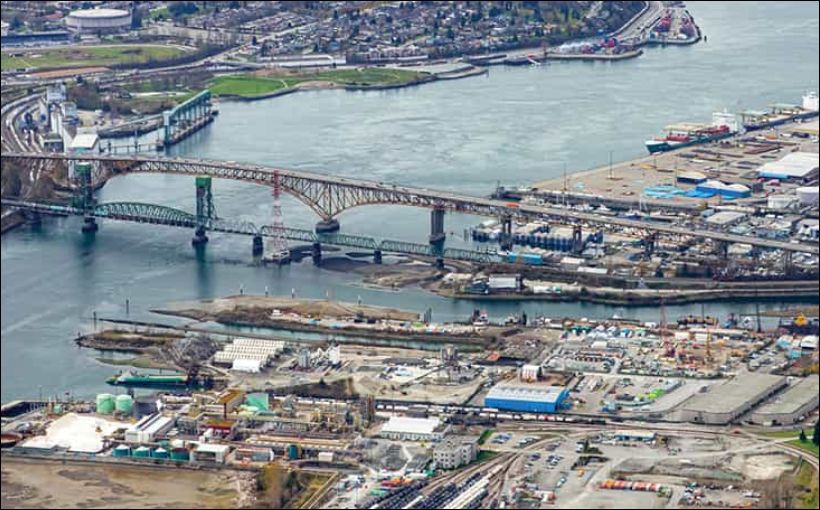
Pictured: Industrial area in North Vancouver, B.C.
Photo: Courtesy of Avison Young