
 Canada
Canada CRE News In Your Inbox.
Sign up for Connect emails to stay informed with CRE stories that are 150 words or less.


Bank of Canada Holds Key Interest Rate at 2.25% Again
The Bank of Canada held its key overnight lending rate at 2.25% on Wednesday amid uncertainty surrounding the war in the Middle East and U.S. tariffs.
The central bank held its key overnight lending rate for the third-straight time following a series of reductions.
“We fully expected the Bank of Canada would hold the overnight rate today, yet again.,” said Mark Fieder, head of Avison Young’s Canadian business. “However, with current socioeconomic instability, there is recent question around whether the BoC could, in fact, hike interest rates at some point later in 2026. This would not be surprising although, naturally, I would rather see interest rates lower, to stimulate investment opportunities – particularly in higher-performing sectors like multi-family, industrial, and retail.
“With current levels of uncertainty around inflation, we will watch to see how economic indicators influence the Bank’s decisions this year, as any moves on the interest rate will have important implications for business and real estate investment.”
Shubha Dasgupta, president and CEO of Canadian mortgage brokerage and fintech platform Pineapple Financial, said BofC is maintaining a wait-and-see approach as policymakers assess the impact of previous cuts.
“With inflation easing, growth softening, and unemployment rising, there is a clear case for patience,” said Dasgupta. “At the same time, geopolitical risks and higher oil prices remain potential sources of renewed inflation pressure.”
For real estate investors and developers, the hold signals “stability more than stimulus,” Dasgupta added. The freeze reinforces the view that interest rates are no longer moving against the market and, therefore, should help support sentiment and planning.
“While it doesn’t resolve affordability or cost challenges, confidence often turns before activity, and this environment may begin to reopen conversations around acquisitions, refinancing, and selective development opportunities,” said Dasgupta.
Like the commercial real estate industry, economists also expected the hold, while markets began to price it in late last week.
“No real surprises here,” wrote TD Bank Director and Senior Economist Andrew Hencic in a research note provided to Connect. “The BoC stayed on hold as expected and highlighted the uncertainty coming from the energy shock.
“The emphasis on keeping inflation pressures from spilling over from energy to other categories was to be expected. What matters in the coming months will be how the assessment and identification of those spillovers are communicated.”
The hold indicates, once again, that the BoC is not overly concerned about a widespread increased in inflation occurring. Although oil prices have risen dramatically in recent days, the BoC appears comfortable that the Canadian economy can withstand the short-term pain.
“We continue to expect the Canadian economy to grow modestly as it adjusts to U.S. tariffs and trade policy uncertainty, but recent data suggest that near-term economic growth will be weaker than anticipated in January,” the Bank said.
BoC Governor Tiff Macklem said following the previous hold that governing council believes Canada’s economy can weather any coming storms tied to the strained Canada-U.S. trade relations and Washington’s uncertain trade policy.
But Macklem has warned that the BoC. could adjust rates in the event of unexpected economic shocks.
Pressure on the BoC eased when Statistics Canada’s latest inflation report showed that the Consumer Price Index did not climb as high as expected, easing further to 1.8% in February from 2.3% in January.
“Against this overall backdrop, governing council decided to maintain the policy rate at 2.25%,” said the Bank. “With recent data pointing to weaker economic activity and uncertainty elevated, risks to growth look tilted to the downside. At the same time, inflation risks have gone up due to higher energy prices.
“We will continue to assess the impact of U.S. tariffs and trade policy uncertainty, and how the Canadian economy is adjusting. We are also monitoring the unfolding conflict in the Middle East closely and assessing its impact on growth and inflation. As the outlook evolves, we stand ready to respond as needed.”
The BoC said it ready to respond as needed and committed to ensuring that Canadians continue to have confidence in price stability through “this period of global upheaval.”
“The war in the Middle East is the dominant factor here,” wrote Hencic. “How long it disrupts supplies of energy products and other goods is the determinant of how big the associated inflationary impact will be.”
If core inflation and inflation expectations drift higher, the BoC will be ready to respond, TD believes.
The BoC also maintained its Bank rate at 2.5% and deposit rate at 2.2%.
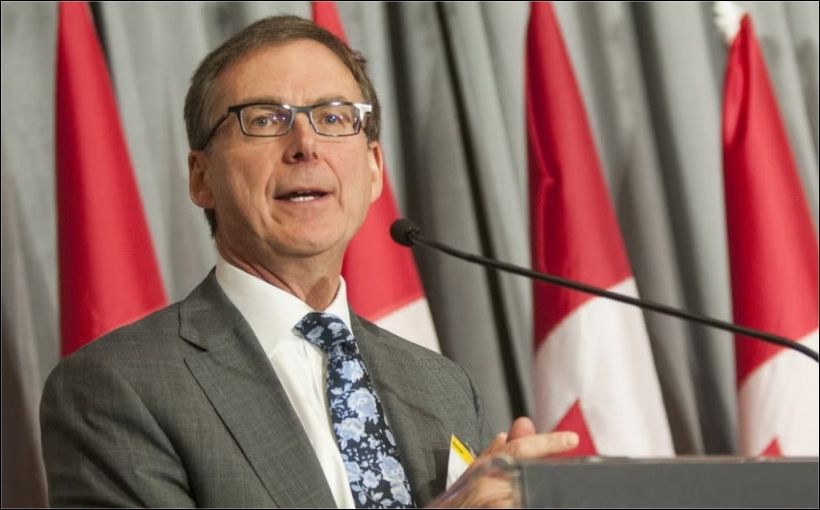
Pictured: Bank of Canada Governor Tiff Macklem
Photo: University of Toronto
- ◦Financing
- ◦Economy
- ◦Policy/Gov't