
 Canada
Canada CRE News In Your Inbox.
Sign up for Connect emails to stay informed with CRE stories that are 150 words or less.


Bank of Canada Holds Key Interest Rate at 2.25%
The Bank of Canada held its key overnight lending rate at 2.25% on Wednesday as its governor expressed satisfaction with the country’s economic performance in the wake of strained trade relations with the U.S. amid ongoing uncertainty.
The widely expected decision came after the central bank introduced cuts earlier this year, most recently in October. Like many economists, Mark Fieder, head of Avison Young’s Canadian business, expects the BoC to refrain from further reductions over the longer term. But the commercial real estate industry would have liked to see another one now.
“Lowering interest rates would be preferred for commercial real estate, stimulating investment opportunities for those who have been on the sidelines as well as those who have already been actively investing in sectors like multi-family, industrial, and retail,” he said.
“We have also seen spikes in activity around office in recent months. Throughout 2026, we will watch how economic indicators influence the Bank’s decisions because any moves on the interest rate will have important implications for business and real estate investment.”
BoC Governor Tiff Macklem said governing council believes that Canada’s economy can weather any coming storms tied to the strained Canada-U.S. trade relations and Washington’s uncertain trade policy.
“After cutting the policy interest rate in September and October, governing council had indicated that if inflation and economic activity were to evolve broadly in line with the October projection, the policy rate would be about right,” he said during a news conference in Ottawa after the decision was announced.
“While information since the last decision has affected the near-term dynamics of GDP growth, it has not changed our view that GDP will expand at a moderate pace in 2026 and inflation will remain close to target. Governing council therefore decided to hold the policy rate unchanged. We agreed that a policy rate at the lower end of the neutral range was appropriate to provide some support for the economy as it works through this structural transition while keeping inflationary pressures contained.”
He noted that Consumer Price Index inflation was 2.2% in October and core inflation measures have remained in the 2.25% to 3% range. Inflation could rise temporarily, but the governing council does not believe that it will get out of hand.
“In the months ahead, we will see some choppiness in headline inflation, reflecting the temporary GST/HST holiday on some goods and services a year ago,” said Macklem. “This is likely to push inflation temporarily higher in the near term. Seeing through this choppiness, we expect ongoing economic slack to roughly offset cost pressures associated with the reconfiguration of trade, keeping CPI inflation close to the 2% target.”
The labour market has seen some improvement as the unemployment rate declined to 6.5% in November. Although trade-sensitive sectors experienced significant job losses earlier in the year, they have displayed more employment stability in recent months. Meanwhile, gains in other sectors — particularly services — have boosted overall employment.
“Looking ahead, however, we’re seeing muted hiring intentions across the economy,” said Macklem.
The economy is proving itself to be resilient despite U.S. tariffs on steel, aluminum and lumber as well as the uncertainty surrounding American tariff policy, he added.
Canadian GDP has performed “much stronger” than the BoC expected, rising 2.6% in the third quarter after falling 1.8% in the second while reflecting Canada-U.S. trade volatility.
“Final domestic demand was flat in the [third] quarter,” said Macklem. “We expect growth in final domestic demand to resume, but with an anticipated decline in net exports, GDP growth is likely to be weak in the fourth quarter before picking up in 2026.”
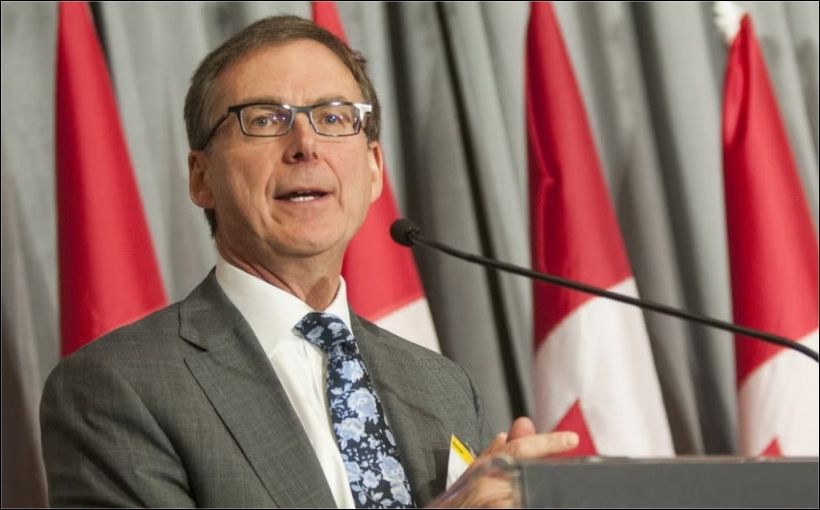
Pictured: Bank of Canada Governor Tiff Macklem
Photo: University of Toronto
- ◦Financing
- ◦Economy
- ◦Policy/Gov't