
 Canada
Canada CRE News In Your Inbox.
Sign up for Connect emails to stay informed with CRE stories that are 150 words or less.


Bank of Canada Holds Key Interest Rate at 2.75% Again
The Bank of Canada held its overnight lending rate at 2.75% for the third-consecutive period on Wednesday due to uncertainty surrounding U.S. tariffs, while suggesting that cuts are possible later this year.
BoC Governor Tiff Macklem said the central bank could cut rates if the tariffs’ effects warrant a reduction.
Meanwhile, the U.S. Federal Reserve also held firm with its benchmark policy rate on Wednesday, keeping it at about 4.3% for the fifth-straight time despite pressure from the White House and internal divisions. The rare dual dissent paired with the Fed’s acknowledgment that economic growth is “moderating,” points to a clear dovish tilt in policy tone.
The BoC’s hold has wide-ranging implications for Canada’s commercial real estate industry. The BoC’s widely expected decision comes as the deadline for a new Canada-U.S. trade deal looms Friday. That deadline appears unlikely to be met.
In a statement, Macklem said the hold is based on three main considerations: Uncertainty surrounding U.S. tariffs and the unpredictability of American policy; Canada’s economy is showing more resilience; and, inflation is close to the central bank’s 2% target but underlying pressures are evident.
“At this rate decision, there was clear consensus to hold our policy rate unchanged,” said Macklem. “We also agreed that we need to proceed carefully, with particular attention to the risks and uncertainties facing the Canadian economy.”
The risks include a spillover of reduced Canadian export demand into business investment, employment and household spending; to what extent and how quickly tariff-related cost increases and disruptions are passed on to the consumer; and how inflation expectations evolve.
“We are focused on ensuring that Canadians continue to have confidence in price stability through this period of global upheaval,” said Macklem. “We will continue to support economic growth while ensuring inflation remains well-controlled.”
Mark Fieder, head of Avison Young’s Canadian business, said the company is not surprised by the BoC’s move.
“We’ve been weathering uncertainty and unpredictability – not solely in commercial real estate but in the overall economic landscape – so I expect the Bank will take the summer to further assess volatility,” he said.
“Between now and their next decision in September, the bank will have a fuller picture of tariff repercussions, cost pressures, and other economic indicators. Come that time, I am hopeful for a rate cut.”
Avison Young’s less cautious clients have already started to come off the sidelines to initiate deals, he added. The company expects that a fall rate cut would spark more movement, particularly in the industrial, multi-family and office markets.
“I would not count out office; it will re-emerge as a real opportunity for investors,” said Fieder.
As with its April rate decision, the BofC did not issue a conventional economic forecast, veering again from its usual practice. Instead the bank presented three scenarios.
The “current” tariff scenario” anticipates how growth and inflation would evolve if trade arrangements remain. The other two examine what could happen if tariffs escalate or de-escalate.
“I want to underline that the lack of a conventional forecast does not impede our ability to take monetary policy decisions,” said Macklem. “But the unusual degree of uncertainty does mean we have to put more weight on the risks, look over a shorter horizon than usual, and be ready to respond to new information.”
Prime Minister Mark Carney said Monday that negotiations with U.S. President Donald Trump’s administration have entered “an intense phase” after the American and U.K. governments struck an agreement recently.
U.S. President Donald Trump told reporters last week that Canada was not a priority for his administration before the deadline.
With files from Joe Palmisano, Connect Money
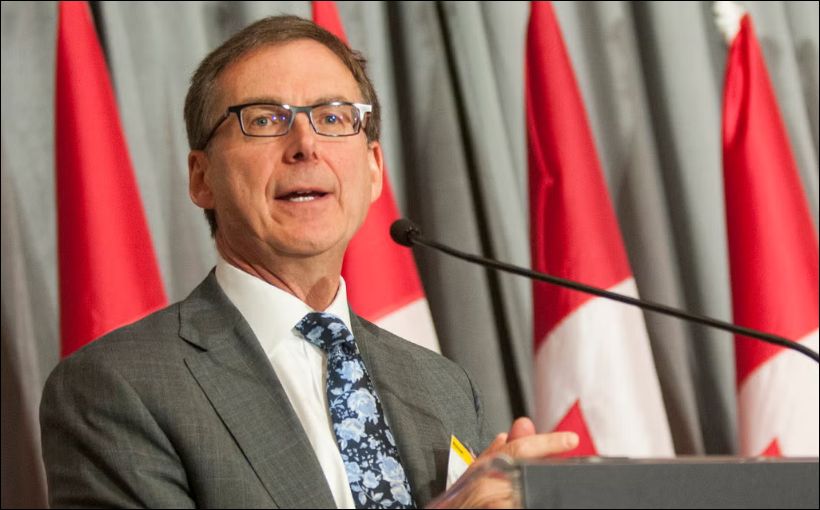
Pictured: Bank of Canada Governor Mark Carney
- ◦Financing
- ◦Economy
- ◦Policy/Gov't