
 Canada
Canada CRE News In Your Inbox.
Sign up for Connect emails to stay informed with CRE stories that are 150 words or less.

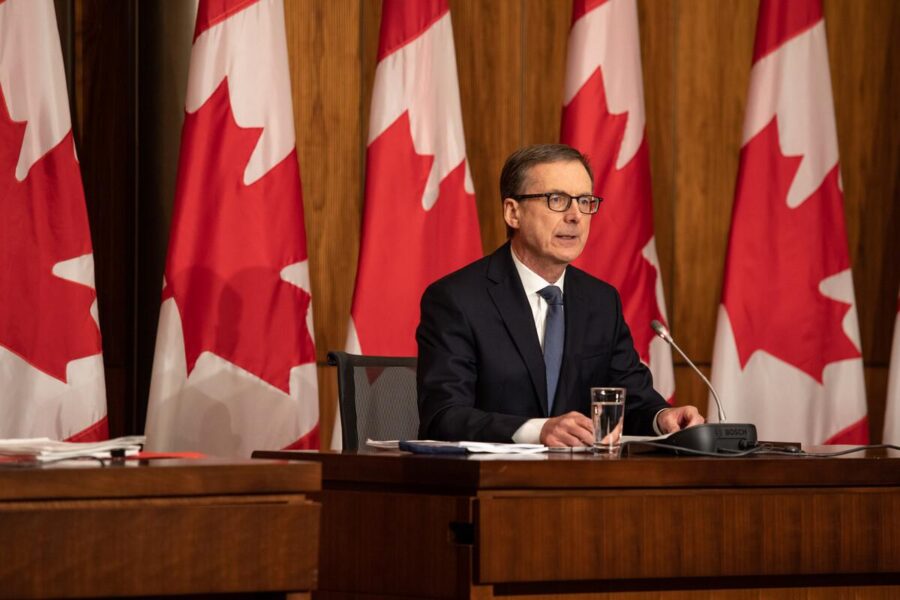

Bank of Canada Lowers Key Interest Rate Again, to 2.25%
The Bank of Canada reduced its overnight lending rate by another 25 basis points to 2.25% on Wednesday, marking the second-straight reduction after a series of holds.
The U.S. Federal Reserve also cuts its prime rate by 25 bps on Wednesday amid a slowing labour market and ongoing pressure on consumer prices.
The BoC’s widely expected cut came amid rising concerns about the effects of U.S. tariffs and policy changes on the weakening Canadian economy. The reduction followed a favourable Statistics Canada September inflation report showing that price increases are being managed sufficiently.
BoC Governor Tiff Mackem said the cut reflects ongoing weakness in the economy and the contained inflationary pressures. The economic weakness is more than a cyclical downturn, he added.
“It is also a structural transition,” he said. “The U.S. trade conflict has diminished Canada’s economic prospects. The structural damage caused by tariffs is reducing our productive capacity and adding costs. This limits the ability of monetary policy to boost demand while maintaining low inflation.”
Mark Fieder, president of Avison Young’s Canadian business, said the cut spells good news for Canadian commercial real estate as the industry starts to see signs of increasing transaction activity in such sectors as office, retail and multi-family.
“Lower interest rates will further stimulate our market, generating appetite from those investors who have been cautiously holding off on the sidelines – while fuelling already-active investors with even more optimism,” said Fieder.
“Although we remain cognizant of a certain level of unpredictability, there is a silver lining with some economic indicators coming in better than expected, namely last week’s inflation report.”
For the first time since January and the start of the Canada-U.S. trade conflict, the BoC released an economic outlook that was formerly standard with interest-rate decisions. Macklem said tariff impacts remain unpredictable but, after six months, are becoming clearer in Canada and globally.
Even as growth recovers, the “entire path” for Canadian GDP is lower, he added. The bank forecasts that GDP will be about 1.5% lower than predicted in January 2025. The bank also anticipates that inflationary pressures will ease in coming months and core inflation will remain near the projected 2% horizon.
Macklem indicated that the bank will hold its key interest rate around 2.25% to keep inflation in that rate, rather than introduce more cuts. He said the bank needs to be humble about its forecast amid the ongoing uncertainty surrounding the damage caused by the tariffs and their impacts. He warned that the increased trade friction means that Canada’s economy will work less efficiently, with higher costs and less income.
“Monetary policy can help the economy adjust as long as inflation is well-controlled, but it cannot restore the economy to its pre-tariff path,” said Macklem.
Meanwhile, the U.S. Fed cut its benchmark federal funds target rate to 3.75% to 4% in a widely anticipated move.
Go to ConnectMoney.com for the full story on the Fed’s cut.
Pictured: Bank of Canada Governor Mark Carney
Photo: Shutterstock
- ◦Financing
- ◦Economy
- ◦Policy/Gov't