
 Canada
Canada CRE News In Your Inbox.
Sign up for Connect emails to stay informed with CRE stories that are 150 words or less.


BoC Holds Key Rate Again, Watches for Potential Hike
The Bank of Canada left its key overnight lending rate unchanged at 2.25% on Wednesday, while warning that rising oil prices and new trade restrictions could still force future rate increases.
It marked the fourth straight rate hold, with the overnight rate remaining at 2.25% since October 29 after four cuts in 2025 aimed at supporting an economy weakened by U.S. tariffs. The U.S. Federal Reserve also kept its prime rate on hold Wednesday, maintaining a range of 3.5% to 3.5%, but the decision exposed growing divisions within the American central bank over the forward path for monetary policy, Connectmoney.com reported.
Commercial real estate and finance leaders were not taken off guard by the BoC’s continuing hold policy.
A recent Reuters poll showed that all 41 economists were unanimous in their expectation of another rate freeze.
“It is no surprise that the Bank of Canada continues to hold the overnight rate,” said Mark Fieder, head of Avison Young’s Canadian business. “While we would prefer to see a cut to further stimulate commercial real estate investment activity, we are keeping a watchful eye on whether the BoC will increase the rate later this year, given a level of global economic uncertainty.
“Despite the uncertainty and paused rates, we note marked activity in the office sector in particular, in both investment and leasing.”
A recent Reuters poll of 41 leading Canadian economists showed that they were unanimous in their expectation of another hold.
Shubha Dasgupta said the hold demonstrates that the central bank is caught between weakening domestic conditions and renewed inflation risk driven by the conflict in Iran, oil supply concerns, and rising energy costs.
“While many Canadians were hoping for clearer signs of rate relief, the Bank cannot move too quickly while fuel, transportation, and broader inflation pressures are resurfacing,” said Dasgupta.
“For the mortgage market, this means fixed rates may remain volatile because they are tied closely to bond yields and inflation expectations. The bigger story remains the upcoming renewal cycle, where millions of Canadians will be renewing into a very different payment environment. This is where advice matters most. Borrowers will need to look beyond rate alone and focus on payment management, debt consolidation, amortization options, and overall household cash flow.”
During a news conference in Ottawa, BoC Governor Tiff Macklem said the central bank’s next move could be in either direction depending on geopolitical developments, including the war in Iran and possible new U.S. tariffs.
“If the United States imposes significant new trade restrictions on Canada, we may need to cut the policy rate further to support economic growth,” he said. “If oil prices continue to increase, and particularly if they remain elevated, the risk that higher energy prices become ongoing generalized inflation increases.
“If this starts to happen, monetary policy will have more work to do — there may be a need for consecutive increases in the policy rate.”
Macklem said the current environment is unusually difficult to assess because the uncertainty is irregular, tied to geopolitical events
“So it’s hard to assess probability,” he said. “There’s no set timeline here. It’s going to depend on conditions. It’s all going to depend on what we see.”
Appear at the news conference, Deputy Governor Carolyn Rogers said the Middle East conflict poses the biggest short-term threat, while trade tensions remain the larger long-term risk.
“In the near-term, it’s the war in the Middle East,” Rogers said. “Over the longer-term, the trade tensions are the bigger threat to the Canadian economy.”
Markets reacted by increasing expectations for rate hikes later this year, The Toronto Star reported.
Benjamin Reitzes, a Bank of Montreal strategist, told the Star that traders moved from expecting one quarter-point increase before the decision to pricing in two hikes by year-end, with some odds of a third.
“That’s a big shift in one day,” he told his interviewer.
Statistics Canada reported last week that inflation rose 2.4% in March from a year earlier, led in part by a 21% increase in gasoline prices. Since late February, oil prices have climbed more than 40%, with West Texas Intermediate reaching US$99.62 a barrel and Brent crude at US$104.30.
“Inflation readings are due to pick up as the energy shock gradually propagates through the economy,” said Andrew Hencic, a TD Bank director and senior economist, said in a research note provided to Connect. “However, they are starting from a good place as near-term measures of core inflation have trended well within the [BoC] target range [of 2% to 3%], and the labour market has remained soft.
“These factors underpin a softer starting point for inflation and the risks the BoC is looking to confront.”
From TD’s lens, he added, the outlook has only “only gradually shifted. While the BoC’s Business Outlook Survey indicates some upside to business confidence, the outlook for firms remains “very murky.”
Potential energy-price hikes are causing worry. But, like the central bank TD expects them to peak during the current quarter and gradually decline, reducing pressure on inflation and allowing the BoC to Energy prices areLike the central bank, TD expects the BoC to “stay on hold” at the lower end of its neutral range.
“Of course, the risks to the outlook [are] high, and remain contingent on the course of the Middle East conflict,” said Hencic.
Meanwhile, the Canadian and American central banks continued to be aligned on monetary policy after a rare deviation at times.
Typically, the BoC does not release details on individual governing council members’ views. The continued holds have not generated any signs of dissent within the ranks, at least publicly as Macklem steers a harmonious crew.
But the U.S. Fed is a different story, with Federal Open Market Committee members’ positions reported regularly. (Jerome Powell, the Fed’s outgoing chief, the U.S. central bank’s seven-member board of governors, the president of the Federal Reserve Bank of New York; and four of the remaining eleven regional reserve bank presidents, form the FOMC.)
Governor Stephen Miran issued his sixth consecutive dissent, favouring a 25-basis-point rate cut, signalling continued concern about the trajectory of economic growth and inflation. At the same time, three regional Fed presidents, Beth Hammack of Cleveland, Neel Kashkari of Minneapolis and Lorie Logan of Dallas, supported holding rates steady but pushed for clearer guidance that future policy moves are not precommitted.
The disagreement marks the most dissents within the FOMC.
The growing dissent within the FOMC could have implications for the BoC in coming rate periods, along with Canada’s commercial real estate industry and the overall economy. The BoC strives to keep its monetary policy aligned closely with the Fed’s position to avoid significant economic disruption.
Wednesday likely marked the last time that Powell chaired the FOMC meeting, according to TD.
Kevin Warsh, the government’s nominee to replace him, is expected to be in place when the Fed makes its next rate decision in June. It remains unclear whether Powell will serve out the final two years of his four-year term by sitting as a governor.
Although Warsh is hawkish on rate cuts, it is “very unlikely” that the Fed will announce a reduction in June because a majority of FOMC members ultimately decide, and it’s becoming very clear that they are reluctant to reduce rates further amid a resilient economy and still elevated inflationary pressures, said Thomas Feltmate in a separate research note provided to Connect.
“We see the Fed staying on hold through at least the summer, with the potential for more rate cuts later this year should inflation show more compelling evidence of moving back towards the Fed’s 2% target,” he said.
— With files from Joe Palmisano, Connect Moey
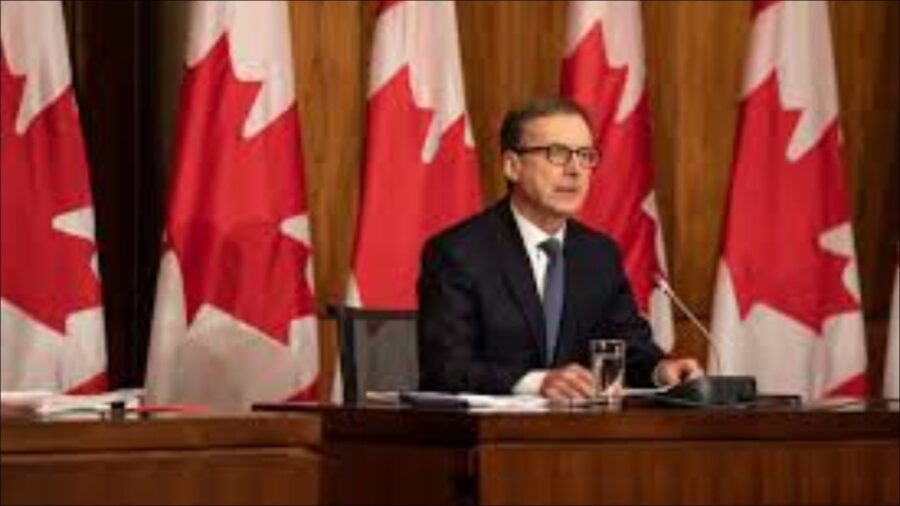
Pictured: Bank of Canada Governor Tiff Macklem
Photo: Shutterstockon
- ◦Financing
- ◦Economy
- ◦Policy/Gov't