
 Canada
Canada CRE News In Your Inbox.
Sign up for Connect emails to stay informed with CRE stories that are 150 words or less.

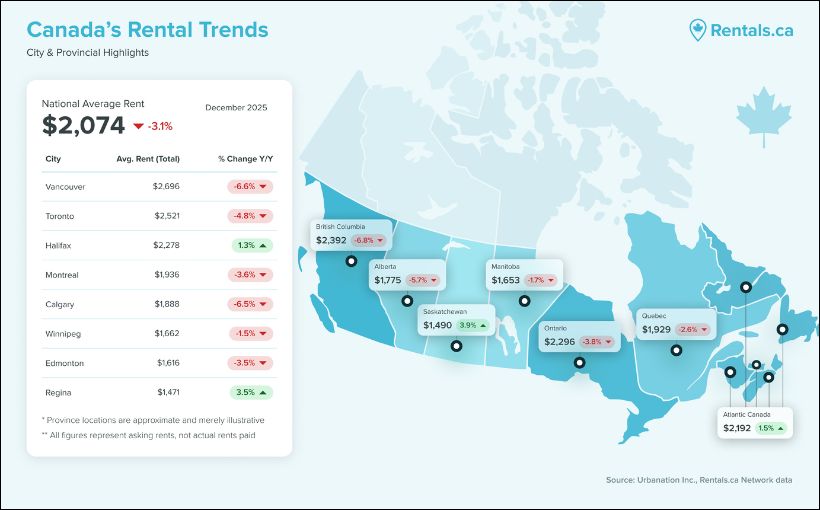

Canadian Apartment Rents Decline for 14th Straight Month
Canada’s average residential rents declined for the 14th straight month in November, falling to $2,074.
The average asking rent for all residential properties declined 3.1% year-over-year, says a new Rentals.ca and Urbanation report released Monday. As a result, average asking rents dropped near an 18-month low.
Average rents fell $100 below the November 2024 level and were 4.6% lower than two years ago. However, average asking rents remained 3.4% higher than three years earlier.
The 1.5% month-over-month decline was the largest of 2025.
“The rental market in Canada continues to face short-term challenges as demand pulls back due to a flattening in population growth and continued economic uncertainty, while at the same time supply ramps up as record number of apartments finish construction,” said Shaun Hildebrand, President of Urbanation. “In this environment, rents can be expected to continue trending down in the next few months during the typical seasonal slowdown.”
All of Canada’s six largest cities posted annual rent declines, with Vancouver rents falling 6.8% year-over-year to $2,692, their lowest level since March 2022, while Toronto rents dropped 5.0% to $2,508 — the lowest since May 2022. Calgary saw a 5.9% decline, while Montreal rents were down 3.3%, Edmonton experienced a 2.8% fall and Ottawa’s average dipped 0.7%.
When it came to unit types, three-bedroom rents increased in Ottawa (+5.0%), Montreal (+2.5%), and Edmonton (+1.9%), while the sharpest annual declines were recorded for two-bedroom apartments in Vancouver (-8.8%) and Toronto (-8.3%).
All provinces except Saskatchewan (+0.5%) and Nova Scotia (+1.8%) saw declines. The sharpest declines were recorded in B.C. (-6.4%), Alberta (-4.3%), and Ontario (-3.5%). On a three-year basis, apartment rents have decreased in both B.C. (-2.6%) and Ontario (-5.2%), while Saskatchewan led growth with a staggering 21.8% increase.
Purpose-built rentals remained the most stable segment as their average rents fell 2% to $2,060. Beleagured condominium-apartment rents suffered a 3.7% dent year-over-year, dropping to $2,087.
However, three-bedroom purpose-built units continued to outperform, increasing 2.5% annually and averaging $2,743. One-bedroom rents took underperformed the most, falling 3.8% year-over-year to $1,811. Meanwhile, two-bedroom units declined 2.1% to $2,179 and three-bedrooms dropped marginally (0.4%) to $2,503.
In the shared-accommodations segment, the average asking rent fell across B.C., Alberta, Ontario, and Quebec declined 8.3% year-over-year to $914, reaching the lowest level in more than two years.
Rentals.ca and Urbanation evaluated rents in single and semi-detached homes, townhouses, condominium apartments rented out by their owners, rental apartments and basement suites.
The two organizations are related entities.
Graphic: Courtesy of Rentals.ca and Urbanation
- ◦Lease