
 Canada
Canada CRE News In Your Inbox.
Sign up for Connect emails to stay informed with CRE stories that are 150 words or less.

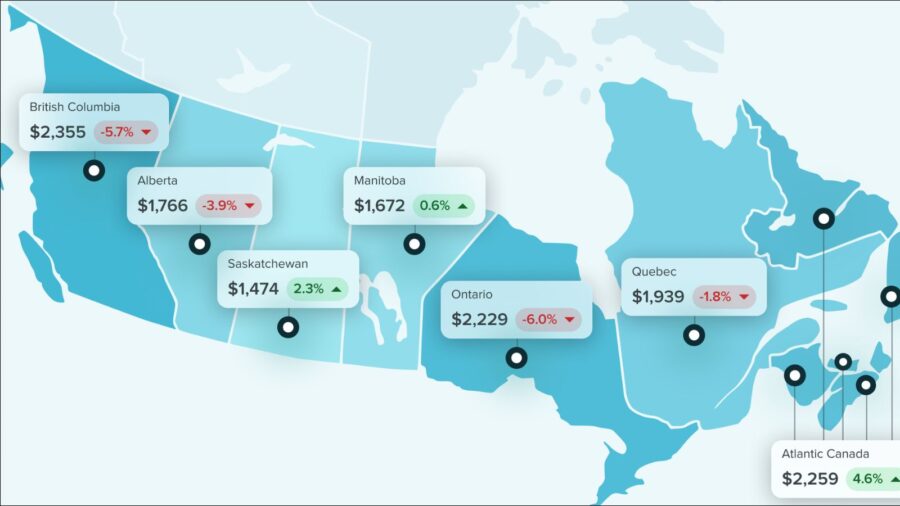

Canadian Residential Asking Rents Decline for 20th Consecutive Month
Canadian residential asking rents fell 4.7% year-over-year in May to $2,029, marking the 20th consecutive month of annual declines, says the latest National Rent Report from Rentals.ca and Urbanation.
Average asking rents were down about $100 from a year earlier and 7.9% lower than two years ago, although they remained 0.7% above levels recorded three years earlier, the report says.
“The Canadian rental market is heading into the peak summer season under a weak economic backdrop, a decreasing population, and record apartment completions, which are all working together to keep rent increases softer than what is typical for this time of year,” said Shaun Hildebrand, president of Urbanation. “This should offer continued relief for renters after years of outsized rent inflation.”
Despite the ongoing annual decline, average rents rose 0.1% from April, although that increase remained well below the average 1.3% gain typically recorded in May over the past five years. Since reaching a peak of $2,202 in May 2024, average asking rents have dropped 7.9%.
Purpose-built rentals showed the most resilience, with asking rents declining 3.4% year-over-year to $2,031. Condo rents fell 6.8% to $2,076, while houses and townhomes dropped 7.7% to $2,004. Three-bedroom purpose-built units recorded a relatively modest decline of 0.5% to $2,729, while studio condominium rents posted the largest decrease among major unit types, falling 8.9% to $1,605.
Provincially, annual apartment rent declines were led by British Columbia (-5.4%), Ontario (-5.0%) and Alberta (-4.7%). Nova Scotia became the country’s most expensive province for purpose-built and condominium apartments, with average rents of $2,343, surpassing British Columbia. Saskatchewan continued to record the strongest long-term rent growth, with apartment rents increasing 26.2% over the past three years.
Apartment rents declined across Canada’s six largest markets, with Calgary posting the steepest annual decrease at 5.1%. Montreal recorded the smallest decline at 0.2%. Vancouver apartment rents fell for the 30th consecutive month on an annual basis and were 5.6% below levels recorded four years ago, while Toronto apartment rents declined for the 28th straight month but remained 3.1% above May 2022 levels.
Suburban markets around major cities continued to post some of the largest rent declines nationally, including Richmond Hill (-14.3%), Longueuil (-13.3%), Markham (-12.9%), Brossard (-11.0%) and Scarborough (-10.6%).
Shared-accommodation rents across British Columbia, Alberta, Ontario and Quebec fell 4.8% annually to an average of $900 in May. Vancouver recorded the largest decline among major markets, with shared accommodation rents falling 15.7% year-over-year to $1,115.
Graphic: Courtesy of Rentals.ca and Urbanation
- ◦Lease