
 Canada
Canada CRE News In Your Inbox.
Sign up for Connect emails to stay informed with CRE stories that are 150 words or less.


Commercial Real Estate Insolvencies Increasing Steadily
Canada’s commercial real estate insolvencies and distressed sales have more than doubled in the past three years, says a leading analyst.
Raymond Wong, a vice-president with market-intelligence firm Altus Group, told The Globe and Mail that Canada’s CRE industry is experiencing its worst real estate cycle in decades as insolvencies and distressed sales continue to mount.
According to Altus, 119 distressed-sale transactions were recorded across Canada in 2023, involving properties valued at $767 million. In 2024, that total rose to 191 transactions worth more than $1.5 billion. Last year, 252 distressed sales were registered, totalling more than $1.42 billion.
Wong told the Globe that the firm defines distressed sales as transactions involving court proceedings such as creditor protection, receivership, foreclosure or power of sale. As a result, the figures do not include properties sold at steep discounts outside of court processes and only capture completed transactions, meaning the overall level of distress is likely higher.
The asset class experiencing the greatest distress is development land, largely because many sites generate no income and developers are struggling to advance projects in the current market. The majority of these distressed situations are concentrated in the Greater Toronto Area and Metro Vancouver, Canada’s two largest residential markets.
Jeremiah Shamess, a broker with Colliers in Toronto who has handled numerous court-ordered sales in recent years, told the Globe that problems are often tied to condominium projects where pricing and buyer demand have weakened.
“The condo pricing at the end has been crystallized, so people know what their end revenue is and what the risk is to closing,” said Shamess in an interview with the publication “That’s causing issues with either a construction project that has gone on too long, or a site that doesn’t have enough revenue to close because they have some buyers who have defaulted on their deposits. That seems to be a pretty common theme today.”
Morgan Iannone, a Colliers colleague based in Metro Vancouver who completed about 10 court-ordered sales in 2024 and 2025, told the Globe that many troubled projects involve developers who moved into unfamiliar types of development during the market boom.
“I would say it’s a lot of new-entrant developers, whether they’re new entrants to development itself or just a new entrant to that form of development,” Iannone told his interviewer. “So, for instance, you have a developer that perhaps had been building homes for many years, and now they’ve moved into condo development or high-rise.
“When the market was continuously going up and you could presell a project in a very short period of time, you’d have groups that were able to progress forward and execute on a presale program because the buyer was there. But when you get into a market where things get a bit more challenging, or delays happen, it just becomes too challenging, and some just don’t have that expertise or experience or, frankly, just the capital in place or partnership capabilities. I think that has really magnified as this has dragged on.”
As insolvencies drag on and property values decline, lenders are increasingly being affected as well. Brokers in British Columbia and Ontario say they are seeing more credit bids, where lenders acquire foreclosed properties using the debt owed to them because acceptable third-party offers fail to materialize, according to the Globe.
“It’s not necessarily the first position they want to be in, but the reason they’re doing it is because there is an ongoing understanding that the market will come back,” Shamess told the Globe. “So at the option of taking a writedown on the loan versus waiting for the market to come back, the general feedback of the lender is that they don’t want to take a significant writedown right now. Whereas I think if there was no certainty that the market would get better at some point, you would likely have a lot more lender fatigue and a lot more writeoffs of the loans.”
Brad Newman-Bennett, a vice-president with Cushman & Wakefield in Vancouver, told the Globe that the downturn is now reaching senior lenders after wiping out more junior investors.
“I would say a couple of years ago there was still the potential for them to get out [unscathed],” he said in the interview. “What we’re seeing now is the second and third guys have been wiped out, and now it’s impacting the first-mortgage lender. Typically, that is the more senior banks – like the Big Five or Big Six or more conventional lenders. I think they’re starting to feel a little bit of this pain.”
According to Newman-Bennett, properties that have $40-million, $50-million, or $60-million debtloads may only be worth $10 million or $15 million, or even less.
“The institutions we all know, like the BMOs, RBCs, TDs of the world, if they have big development deals, they’re absolutely getting hurt at the moment – or if they had to sell, they would hurt,” he told the Globe. “So that’s where I think you’re getting these credit bids. The banks are not prepared to write off a 40%, 50%, 60% loss. There hasn’t been a lot of commentary on that, but I think it’s real.”
Asked his Globe interviewer whether lenders are in denial about falling land values, Newman-Bennett said that may change as more distressed assets come to market.
“I think there’s a little bit of denialism going on,” he told the Globe. “I don’t think they fully appreciate the depths of where things are at the moment, from a land perspective. So maybe they have their head in the sand a little bit. But I think the more of these that come to market, the more of these that are out being marketed by myself and our competitors and the feedback that I think these lenders are getting from us, they’ll start realizing pretty soon the reality of what these loans are actually worth at the moment. Whether they’ll acknowledge that, I don’t know.”
Wong told the Globe that the pace of distressed sales has moderated slightly from the peak, but further insolvencies are likely.
“Right now, the number has been slowly coming down from 2024 to 2025,” Wong told the Globe. “That’s because there’s less of that pressure and distress. But that’s not to say that in the next six months, depending on the velocity of the market, we won’t see more.
“That’s the challenge with this. I don’t think we’ve hit the bottom yet.”
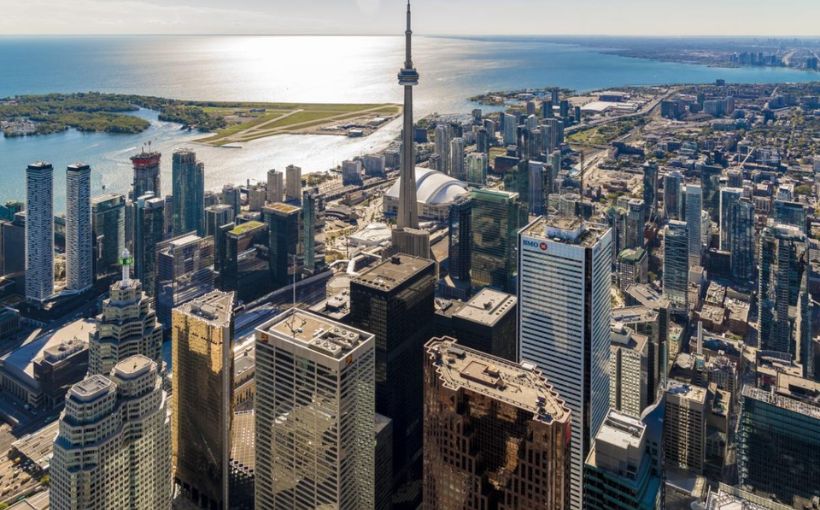
Pictured: Downtown Toronto
Photo: Shutterstock.com
- ◦Lease
- ◦Sale/Acquisition
- ◦Development
- ◦Financing
- ◦Economy
- ◦Policy/Gov't