
 Canada
Canada CRE News In Your Inbox.
Sign up for Connect emails to stay informed with CRE stories that are 150 words or less.

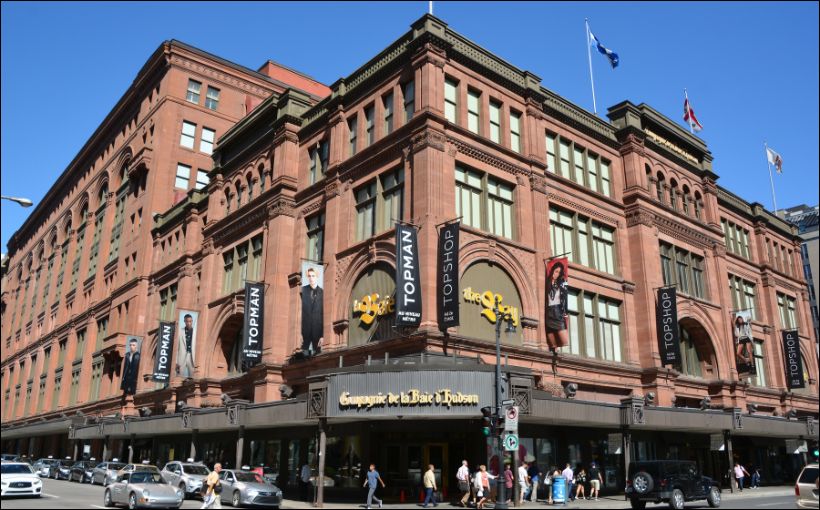

Former Downtown Hudson’s Bay Company Stores Unlikely to Remain Retail Spaces
Former downtown Hudson’s Bay Company department stores are unlikely to continue being used for retail purposes, say commercial real estate experts.
A number of former downtown Bay stores, including those in Montreal, Toronto, Ottawa, and Vancouver, did not receive any bids as part of the company’s restructuring process under creditor protection. Their leases are reverting to landlords, who will decide what to do with the properties once they are cleared to do so.
“The highest and best use is probably not for [each property] to be [like] a Bay,” said Adam Jacobs, Colliers’ head of Canadian research in an interview with Connect. “It’s going to end up as something else, a luxury hotel, a new office tower, an apartment building [or] public infrastructure.”
Kingsley Ma, a Re/Max regional vice-president, said it’s difficult to say what will happen to the downtown former Bay locations because every space is different.
“I know a lot of them were really more on the heritage side of things, where you can’t really [demolish] it,” said Ma in an interview with Connect. “So, the landlord will have to be creative.”
Depending on the location, the stores will probably be repurposed into smaller retail spaces.
“If it’s buildings that are older, especially that are older and can be reconstructed, I think that’s where the trend will be,” said Ma.
Some Bay landlords may also choose to repurpose their downtown stores as mixed-use assets, he added. Doing so would enable the sites to be leased by large corporations, as happened with the former Canada Post headquarters in downtown Vancouver. Now owned by Germany’s Deka Bank, the redeveloped two-building site, known as the Post, is leased mainly to Amazon.
“That’s one way they can do it,” said Ma.
He noted that the former downtown Bay stores are high-demand, trophy-class properties due to their prime locations. Multiple parties have submitted bids to acquire the former Bay store in downtown Montreal, according to The Montreal Gazette.
Colliers’ Jacobs said Bay-type properties are more essential in suburban malls than downtown.
“There’s just so many more retail options [downtown],” he said. “The value is more just in the building itself or the location itself, not the Bay as a retail outlet anymore.”
In Jacobs’ view, investors decided not to seek the leases because they want to redevelop the assets.
“It’s challenging and there’s a better use for that,” he said. “We have one [former downtown Bay store] here in Toronto. It’s a multi-storey department store, but it’s in an amazing location, in a heritage building, and it’s probably destined to be anything but a department store.”
He called the demise of the 355-year-old company “sad” but predicted that landlords will be content in the long run, after dealing with short-term financial pain.
He predicted that will be the case for downtown Bay landlords as well as they’re suburban counterparts, which are one and the same in a number of cases.
Many Bay store leases date back decades and are undervalued in comparison to more expensive modern ones paid by neighbouring retailers.
In some ways, the Bay was a difficult tenant because of how the company limited what landlords could do with their properties, said Jacobs.
“[Landlords are] going to chop the space up, or they’re going to have three smaller leases instead of one bigger lease,” said Jacobs. “I still think, long term, maybe five years from now, landlords are going to be happy just because the Bay wasn’t the attraction that it was, I don’t know, 20 or 30 years ago or something like that.”
The whole idea of a big corner anchor store has faded, he added.
“I think we’re just at the point where there are no big anchor stores left,” said Jacobs. “There is no next Bay that is going to come in and fill this.
“We went through this with Nordstrom and Sears and Target and Eaton’s. We’re just at the point of: That’s it. There’s nothing left.”
U.S. chains Nordstrom and Target exited the Canadian market in recent years. Sears and Eaton’s are now defunct.
“I think we’re going to give [former Bay stores in malls] creative uses, whether that’s pickleball [courts] or a food hall,” said Jacobs. “We’ve seen a bunch of solutions to these sort of things, but they tend not to be in the paradigm of department stores.”
Pictured: Hudson’s Bay store in downtown Montreal.
Photo: Shutterstock