
 Ontario
Canada CRE News In Your Inbox.
Sign up for Connect emails to stay informed with CRE stories that are 150 words or less.


Southwestern Ontario Office, Industrial Markets at Different Cycle Points
Southwestern Ontario’s office and industrial real estate owners and tenants are taking different approaches as they start to see long-awaited growth in the post-pandemic era and deal with more market challenges, says a leading executive in the region.
“Office and industrial are in quite different stages in the cycles,” said Mitchell Blaine, a JLL executive vice-president and the firm’s Southwestern Ontario practice leader.
The two sectors will be leading discussion topics Thursday as Blaine chairs the Southwestern Ontario Real Estate Forum in London, Ont.
Office growth is returning in the region in the aftermath of the COVID-19 pandemic as tenants focus on employee return-to-office policies. As a result, said Blaine, tenant demand has increased considerably.
The region’s office sector is seeing “classic signals” of an upswing, including a flight to quality and appealing amenities that include such basic cost elements as free parking, highway and transit access and relative affordability in comparison to larger cities in the Greater Toronto Area.
“It’s only a matter of time before we see further move-down in the quality scale, just because that’s all that’s available,” said Blaine, referring to class B and C spaces.
“We turned the tap off on building new office buildings about five years ago. So, we’re quickly now absorbing that vacancy. The office market, generally speaking, is on the upswing. It was a pretty deep trough. But you can see the trajectory that we’re on in that cycle.”
Meanwhile, tenant activity has increased considerable in the region’s industrial sector during the past few weeks following the federal election and signs of tariff alignments.
“It’s giving a lot of the industrial tenants some signals that they can start planning again for what the next stage of their growth looks like,” said Blaine.
But due to reduced product sales, industrial tenants need to recalibrate their space and capacity needs.
“So, there’s a lot of scenario-planning going on,” he said. “But we’re seeing early days of a re-engagement with the market, because we did see, following [U.S. President Donald Trump’s] Liberation Day and some of the tariff announcements, a real pause across all of the industrial-sector tenants regardless of the industry they’re in.”
As tenants follow active capital, both office and industrial investments will increase, he predicted.
“We do believe that, at some point, we will see an uptick in investment in office in our part of the world,” said Blaine.
The tariff situation is still causing pain.
“But it hasn’t run nearly as long as COVID did,” said Blaine. “So, the depths that we might have to deal with, some collateral damage in industrial real estate, might not be as deep.
“But it’s still very early to tell.”
Hosted by Informa, the forum is expected to attract about 500 attendees. Outlooks on other asset classes will also be discussed.
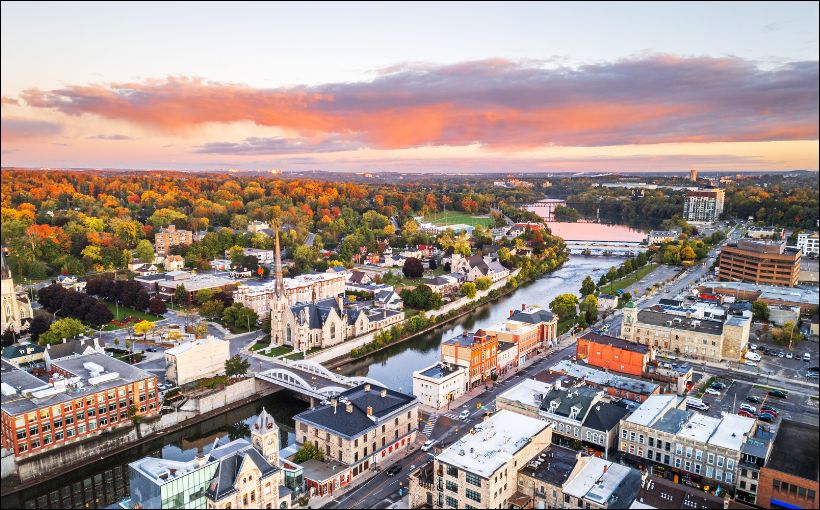
Pictured: Cambridge, Ont.
Photo: Shutterstock