
 B.C.
B.C.Canada CRE News In Your Inbox.
Sign up for Connect emails to stay informed with CRE stories that are 150 words or less.

Telus to Develop Three AI Megafactories in B.C.
Telus is developing three sovereign AI megafactories in British Columbia as part of a proposed collaboration with the federal government under Canada’s Enabling Large-Scale Sovereign AI Data Centres initiative.
The Vancouver-based telecommunications company said the facilities will scale to more than 60,000 graphics-processing units (GPUs_ and 150 megawatts of capacity by 2032, creating what it describes as one of the world’s most powerful and sustainable sovereign AI infrastructure clusters.
“We are incredibly proud to be working with the Government of Canada to help build Canada’s sovereign AI infrastructure,” said Darren Entwistle, president and CEO of Telus. “The unprecedented demand that completely sold out our first AI Factory in Rimouski proves that Canadian innovators want cutting-edge AI built right here on Canadian soil.”
Telus said its first Sovereign AI Factory in Rimouski, Que., which opened in September 2025, is fully sold out and is recognized as Canada’s fastest and most powerful supercomputer on the global TOP500 list.
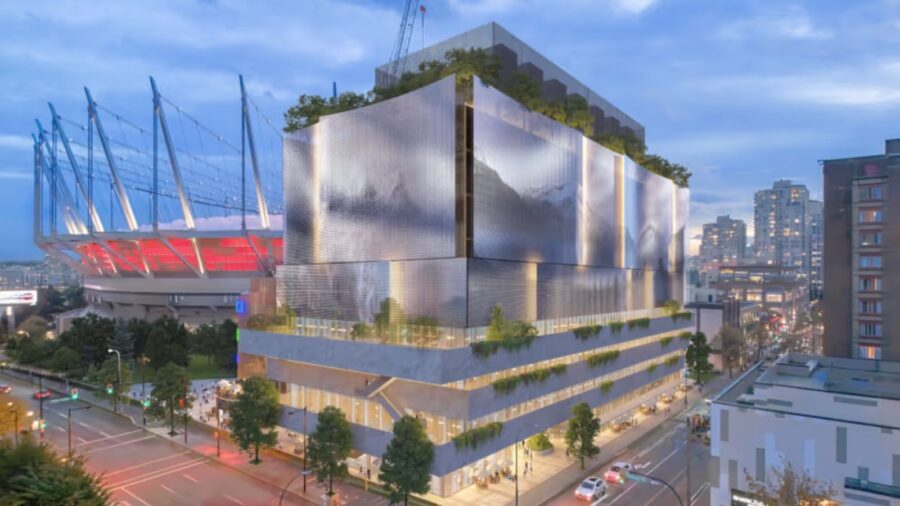
The company is now expanding its network in B.C. by enlarging its existing Kamloops data centre and developing two Vancouver facilities with Westbank and its partners. The Kamloops facility is expected to come online later this year, while the M3 facility in Vancouver’s Mount Pleasant neighbourhood is slated to open at the end of 2026 and scale through 2028. A third site at 150 West Georgia in Vancouver is expected to launch in 2029.
“Securing Canada’s technological independence is a national priority, and it requires building the infrastructure to back it up,” said federal AI Minister Evan Solomon. “By working with Telus, we are taking concrete action to strengthen Canada’s sovereign AI capacity and ensure that Canadian innovation, data, and economic advantages are anchored in Canada.”
Telus said the facilities will run on 98% renewable energy and incorporate closed-loop liquid cooling and heat-recovery systems designed to reduce cooling energy consumption by 80% and water consumption by 90% compared with conventional data centres.
The company added that waste heat generated by the facilities will be recycled into district energy systems to heat the equivalent of 150,000 homes in Metro Vancouver and support the decarbonization of more than 50 million square feet of real estate.
“People toss around the word innovation lightly, but this is a story of true Canadian innovation,” said Ian Gillespie, founder and CEO of Westbank. “After years of R&D, working with our partners at Telus, BC Hydro, Creative Energy, the City of Vancouver, province of B.C. and now the federal government, we have arrived at the most elegant low-carbon solution – effectively using every electron twice, to produce environmentally responsible sovereign AI infrastructure.”
Telus said the three-site cluster will use advanced NVIDIA GPU infrastructure to support large-scale AI model training, simulations and deployment. The company noted it is the first North American service provider to become an official NVIDIA Cloud partner.
“Telus has proven over the past year that sovereign AI infrastructure built on trusted telecom platforms delivers real results; in fact, AI-native companies are already training, deploying, and scaling on Telus’ NVIDIA-powered platform,” said Ronnie Vasishta, senior vice-president of telecom at NVIDIA.
Once fully operational, the project is expected to generate about $9 billion in economic value for British Columbia, create more than 1,000 construction jobs and hundreds of high-skilled operations roles, according to Telus.
“Through our Look West strategy, B.C. is ensuring our clean electricity is directed where it delivers the most value for British Columbians,” said Ravi Kahlon, the province’s minister of jobs and economic growth.
Vancouver Mayor Ken Sim said the facilities would help position Vancouver as a leading technology hub and support the next generation of AI applications requiring ultra-low latency infrastructure.
Pictured: Proposed future Telus AI megafactory in downtown Vancouver.
Rendering: Telus
- ◦Development
- ◦Economy
- ◦Policy/Gov't