
 Cross Border News
Canada CRE News In Your Inbox.
Sign up for Connect emails to stay informed with CRE stories that are 150 words or less.


U.S. Imposes New 10% Tariffs on Imports from Canada, 59 Other Economies
The U.S. government imposed new 10% tariffs on imports from Canada and 59 other economies on Friday, citing the products’ ties to forced labour.
All of the duties comprise a minimum 10% threshold, with some as high as 12.5%.
The new duties affect Canada, the European Union and other countries, replacing a temporary tariff that expired Friday. Unlike with Donald Trump’s planned new 50% duties on imports from north of the border, Canadian exports that comply with the Canada-United States-Mexico Agreement rules of origin remain exempt, leaving the scope and rate of existing U.S. tariffs on those goods unchanged.
The Trump administration said the tariffs are justified because the affected countries have failed to do enough to prevent products made with forced labour from entering their supply chains. The move follows a U.S. Trade Representative investigation that concluded that all of the affected countries failed to meet U.S. standards on banning imports produced with forced labour.
Canadian officials and analysts have disputed U.S. claims that Canada imports goods produced by forced labourers. Canada is known internationally for its strong stance against forced labour and human trafficking.
The new tariffs replace the temporary 10% levy introduced in February after the U.S. Supreme Court struck down the administration’s original global tariff regime. President Donald Trump’s administration is now relying on Section 301 of the U.S. Trade Act, which allows tariffs in response to unfair trade practices. Canada, the European Union, the United Kingdom, Argentina, Bangladesh and Pakistan are among the jurisdictions facing the 10% tariff, while another 44 countries, including Japan, India, South Korea, Singapore and Vietnam, face tariffs of 12.5%, according to CBC.
Canada-U.S. Trade Minister Dominic LeBlanc rejected the rationale for including Canada.
“Canada shares the United States’ objective of ensuring goods produced with forced labour do not enter our supply chains,” LeBlanc said in a statement. “We will continue engaging constructively with the United States on this matter, as well as other outstanding issues, over the coming weeks.”
Earlier this month, the federal government formally disputed the U.S. allegation that Canada allows the importation of goods made with forced labour.
U.S. Congressman Richard Neal, the ranking Democrat on the U.S. House Ways and Means Committee, also criticized Washingon’s new tariff policy.
“Forced labour is a real and pervasive problem in our supply chains and demands serious enforcement,” Neal said. “It should never be cheapened into a pretext for a tariff policy built on dubious legal theories and personal grievances.”
Oregon Sen. Ron Wyden, the top Democrat on the U.S. Senate Finance Committee, called the new tariffs “a blatant attempt to revive Trump’s illegal global tariffs under a different name.”
“These latest tariffs will continue to keep inflation and prices high for Americans, and do nothing to help workers around the world,” said Wyden.
The Liberty Justice Center, a libertarian advocacy group, has already filed a lawsuit against the new tariffs in a specialized trade court. The group filed the lawsuit on behalf of two American small businesses: New York-based online retailer Burlap & Barrel, which sells spices sourced from smallholder farmers and producer co-operatives, and Collective Horology, a California watch retailer and distributor thats support independent watchmakers, including those made by American, Swiss and other European craftspeople, by importing their watches and introducing them to U.S. customers.
“Forced labor is morally indefensible, but an important objective does not give the government permission to ignore the law,” said Sara Albrecht, Chairman and CEO of the Liberty Justice Center. “The administration allowed one global tariff to expire and immediately replaced it with another under a different statute. Changing the statute doesn’t change the law. Every tariff authority has limits, and every administration must respect them.”
The latest tariffs are separate from existing U.S. sectoral duties on steel, aluminum and automobiles, as well as the proposed 50% tariffs on certain Canadian goods that the Trump administration has threatened to impose beginning Aug. 19 over alleged discrimination against U.S. commerce in the alcohol, dairy and automotive sectors.
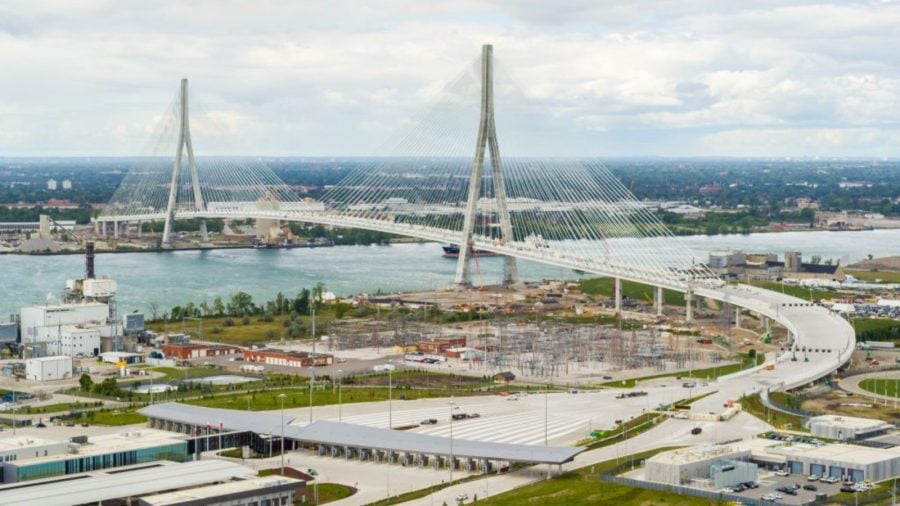
Signs of the strained Canada-U.S. trade relations were amplified Friday as Canadian government alone celebrated the official opening of the new Gordie Howe International Bridge between Windsor, Ont., and Detroit. Canada rescinded invitations to U.S. officials after Trump threatened to impose the new 50% tariffs.
The toll bridge’s opening ceremony was delayed after Canada and the U.S. bickered over the distribution of the tolls’ revenues. The two countries have since come to an agreement on toll distributions but providing contradicting statements on the terms of the deal.
Canada is covering the costs of the bridge’s construction. Canadian Prime Minister Mark Carney has indicated that Ottawa will receive toll revenues after Canada’s construction costs have been covered, but the Trump administration claims that it will receive revenues earlier.
Although the opening ceremony was held Friday, the bridge was not expected to be open to vehicles until early Monday.
The new minimum-10% tariffs are expected to precede new levies that will raise duties closer to the emergency rates that Trump imposed in 2025, The Washington Post reported.
“The forced-labour tariffs are not the end of the story,” Patrick Childress, a partner at Holland & Knight, told the Post.
Pictured: New Gordie Howe International Bridge between Windsor, Ont., and Detroit.
Photo: Gordie Howe Bridge