
 B.C.
B.C.Canada CRE News In Your Inbox.
Sign up for Connect emails to stay informed with CRE stories that are 150 words or less.

Whitecaps Agree to One-Year B.C. Place Stadium Lease Deal
The Vancouver Whitecaps have agreed to a one-year lease agreement at BC. Stadium.
Axel Schuster, the team’s sporting director and CEO, told reporters that the Major League Soccer team had come to a deal after previously being at an impasse. The agreement came after the provincial owned B.C. Pavilion Corporation (PavCo), the venue’s landlord, agreed to give the Whitecaps the approximately $1 million to $1.5 million in profit that it generates annually from the team’s games.
Schuster said the club and PavCo’s lawyers are finalizing the deal. An impasse had appeared to remain after (PavCo) made a revised offer that would see the province operate the facility at “net-zero” profitability on the club’s tenancy. In other words, PavCo would only break even on Whitecaps games.
“We actually want to thank them,” Schuster told reporters from Spain, where the team is holding its training camp. “Even if it is only a little step, it’s a little step and it’s meaningful dollars.”
But, he added, PacCo needs to make many more “small steps” before the Whitecaps can commit to a long-term lease at B.C. Place.
“We remain fully committed to doing everything we can to continue our partnership with the Vancouver Whitecaps and to help the team stay in B.C. and at B.C. Place for many years to come,” the statement said.
Jobs and Economic Growth Minister Ravi Kahlon previously said that the provision of the province’s profit increase the team’s desire to stay at B.C. Place for a longer period.
We believe that by returning those profits, and giving them a new contract that essentially has them operating at net zero, that should make the proposition of them wanting to stay much better,” Kahlon said.
But Whitecaps Schuster said in a previous statement issued by the team that the offer fell short of what the club needs to remain financially viable at the 55,000-seat downtown stadium.
“Unfortunately our gap between being top seven in attendance and last in revenue is so significant that this effort alone isn’t the game changer that is needed for long-term sustainability,” Schuster said.
In many cases, a $1-million to $1.5-million rebate would be less than what the team plays an average-skilled player per season, let alone a star. The Whitecaps have considerably less control over their home than many other MLS clubs and, therefore, fewer opportunities to generate large revenues.
The province also pledge to provide “additional revenue opportunities for the team.
The two sides are negotiating a new long-term lease at B.C. Place as the Whitecaps also explore the possibility of building a new stadium at city-owned Hastings Park adjacent to the Pacific National Exhibition grounds, located on Vancouver’s, eastern edge under a memorandum of understanding with the City of Vancouver signed in late 2025. Hastings Park and the exhibition grounds are generally known as the PNE.
The potential lease area sits within the existing Hastings Racecourse footprint, which has included space used for horseracing this season, which ended in October, and casino operations. Since 1889, the racecourse has been the home of horseracing in Vancouver. But operator Great Canadian Entertainment unexpectedly shut down the racetrack business, effective immediately, in early December.
The existing casino business, now owned by a First Nation, continues to operate.
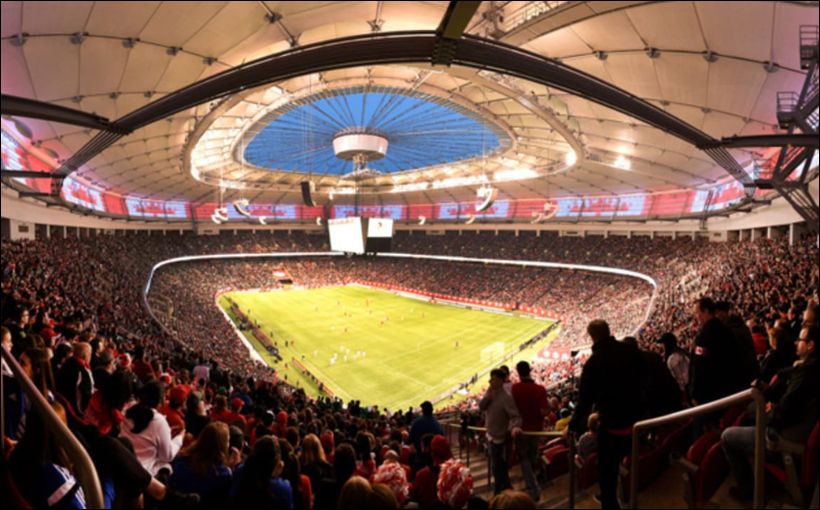
Major League Soccer’s planned shift to a traditional fall-to-spring schedule from the current spring-to-fall version beginning in the 2027–28 season has heightened the importance of B.C. Place, which has a retractable roof that can be closed for matches played in cold weather.
Both the club and the league have said the existing lease agreement limits scheduling flexibility and food-and-beverage revenue. But the reality is that the Whitecaps need another B.C. Place lease deal before they can even plan to move into a stadium of their own at the PNE.
Under their MOU with the city, the Whitecaps will spend the next year evaluating the possibility of developing a stadium at the PNE. If a development is deemed worthwhile, it could take another year or more to build the new facility, with the team responsible for construction costs.
Ultimately, a B.C. Place lease renewal is simpler for the Whitecaps than developing a new stadium. A renewal would help the team avoid the expense of building a new stadium, which they would incur under the partnership with the city. The Whitecaps would also be spared from facing political and regulatory roadblocks that could delay construction and a final investment decision.
The PNE area lacks major transit infrastructure, a key factor that prompted both the Whitecaps and B.C. Lions of the Canadian Football League to relocate downtown following the construction of B.C. Place in the early 1980s, which Vancouver hoped to land a Major League Baseball expansion franchise.
The move downtown enabled the Whitecaps and Lions to benefit from the construction of the SkyTrain network a few years later, in advance of Expo ’86, and make the teams more accessible from the suburbs. Those fans appear to be the team’s staple these days.
But the cavernous stadium has become too large and impractical for the Whitecaps, hampering fan-player coziness that the team covets. And, limited new-revenue opportunities have added to the team’s distaste for the venue.
The Whitecaps previously sought to develop their own soccer-specific stadium on downtown waterfront land owned by publicity-shy Caps majority owner, Greg Kerfoot, who lets co-owners and club executives discuss team matters. But the downtown plan was effectively nixed years ago, after the commercial real estate industry strongly opposed it and the Whitecaps signed a long-term B.C. Place Stadium lease renewal.
With the team up for sale since late 2024, MLS Commissioner Don Garber has warned that the team could leave Vancouver if a more suitable stadium arrangement is not worked out. Following the latest impasse, Moshe Lander, a sports economist told CTV that the stalemate was increasing the team’s chances of leaving Vancouver.
“We remain fully committed to doing everything we can to continue our partnership with the Vancouver Whitecaps and to help the team stay in B.C. and at B.C. Place for many years to come,” PavCo said in its statement.
Pictured: B.C. Place Stadium
Photo: Courtesy of Vancouver Whitecaps