
 Canada
Canada CRE News In Your Inbox.
Sign up for Connect emails to stay informed with CRE stories that are 150 words or less.


Provincial Budget Allocations Could Boost MF Development: Paskowitz
New Ontario budget allocations and proposed legislation could have a big impact on multi-family real estate investment and development, says an industry leader.
Howard Paskowitz, vice-president of development and public affairs for Toronto-based Starlight Investments, expressed deep praise for the measures in an interview with Connect. The budget allocations include the $1-billion Municipal Housing Infrastructure Program and the $1-billion Housing-Enabling Water Systems Fund. He believes that the measures will encourage the real estate industry to increase purpose-built rental investments and projects.
“We definitely applaud the Ontario government, and definitely the minister of housing [Rob Flack] for coming out of the gate quickly to try to address this housing crisis that we have,” said Paskowitz. “Ontario is facing a critical housing shortage as a result of decades of chronic under supply of housing.”
In the Greater Toronto Area, said Paskowitz, 87% of purposeful rental apartments were built prior to 1980. The supply-demand imbalance has fuelled “a critical shortage of rental options across the housing spectrum,” he added.
As one of Canada’s most active purpose-built rental-housing developers Starlight is “very encouraged” by the measures outlined in the recently introduced budget.
He and Starlight believe that Bill 17 could also accelerate transit-oriented development, which means development capitalizes on, and uses, existing and proposed new infrastructure.
Paskowitz called the potential new Protect Ontario by Building Faster and Smarter Act “a bold piece of proposed legislation,” noting that it includes measures related to red-tape reduction, development charge reform and standardization of development study requirements. Such efforts, he added, help to get projects approved faster and accelerate the expansion of transit-oriented communities.
In recent years, he said, municipalities have taken a “much stronger and bolder” approach to expediting development approvals. He said the provincial measures will not only change the rules, but also changes cities’ attitude towards development.
“I think that starts by having a real appreciation for the housing shortage,” said Paskowitz. “As we’ve seen over the past few months, and as we expect in the coming years, there is going to be a real shortage of new condo development, and so we need to see that gap filled by new rental development, and a focus by the province and municipalities on expediting approvals will certainly help to deliver more housing faster.”
If passed, Bill 17 could give the infrastructure minister the authority to exempt TOD projects from traditional zoning and planning requirements.
“In practice, this means the province can now bypass municipal-approval processes that have, at times, slowed down or blocked high-density mixed-use developments around transit hubs,” said Paskowitz. “As we know from our focus on complete communities, it’s very important that we build around existing infrastructure. Transit is crucial to the success of development. We need to provide places for people to live, but we need to provide ways for those people to get around.”
“For Starlight, [Bill 17 is] a major shift. We think it removes a critical bottleneck, which are municipal delays. It allows the province to really to directly green-light, to see projects in transit-oriented communities that align with provincial growth in transit goals. If the proposed legislation is passed, this new authority will function like the minister zoning order specifically for transit-oriented communities, which streamlines approvals and creates more predictability for developers, he added.
“I think what it does really is, it prioritizes where we are going to be providing homes,” said Paskowitz. “We need housing everywhere, and the best place to put that is along existing infrastructure to take advantage of the existing infrastructure that is in place.”
Focusing on major transit corridors will help developers put new housing where it’s needed most and where it can serve communities best, he contended. He also believes that a provincial framework offering a predictable and streamlined development process will also encourage more investment in rental-housing development and greater compliance with resident-protection standards.
“This will encourage improvements to existing rental communities and brings new energy-efficient buildings into these neighbourhoods.
Meanwhile, he anticipates that the Municipal Housing Infrastructure Program and Housing Enabling Waster System fund will encourage the development sector to increase investment in the multi-family sector.
As investors and developers expand their existing rental communities and build new ones, additional upgraded and new infrastructure will be required. He noted that the government is investing $400 million in the immediate term to address high demand. That investment is in additional to the total $2 billion allocation in the municipal housing infrastructure and water-system funds.
He said the province needs to take a leading role in the development of infrastructure that will enable additional housing.
“It’s great to build the housing, but you need the infrastructure to support it,” said Paskowitz.
Starlight is eager to collaborate with the province on its initiatives. He would like to see a variety of consultation efforts between the province and all interested parties, ranging from roundtable discussions to public-consultation sessions to one-on-one meetings, to help determine the best solutions.
Although the government is “making progress” with its latest efforts, further reforms are needed to help boost housing supply, said Paskowitz.
Starlight is calling for development-charge waivers that are now available in Toronto and Mississauga to be provided across the GTA. Paskowitz also wants to see measures that will enhance building-structure and community security and reductions in administrative delays that extend disputes between rental-property owners and residents, among other provincial initiatives.
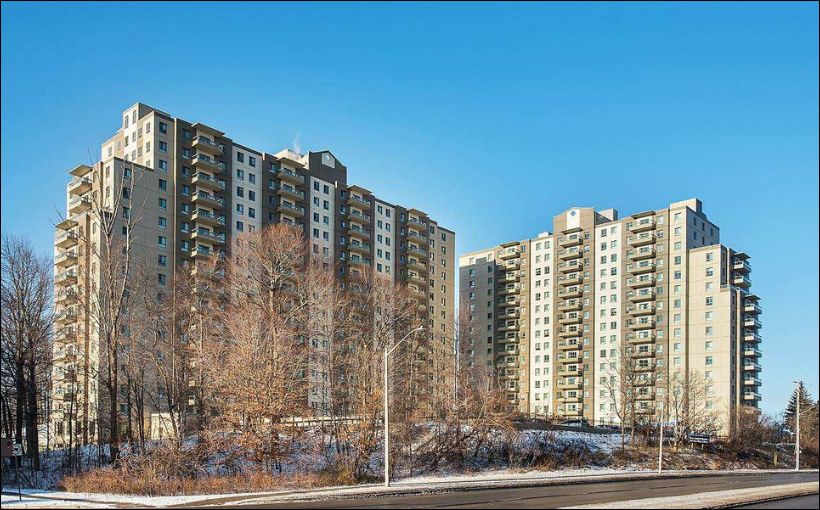
Pictured: Two Starlight-owned apartment buildings in Kitchener, Ont.
Image: Courtesy of Starlight Investments
- ◦Lease
- ◦Sale/Acquisition
- ◦Development
- ◦Financing
- ◦Policy/Gov't